
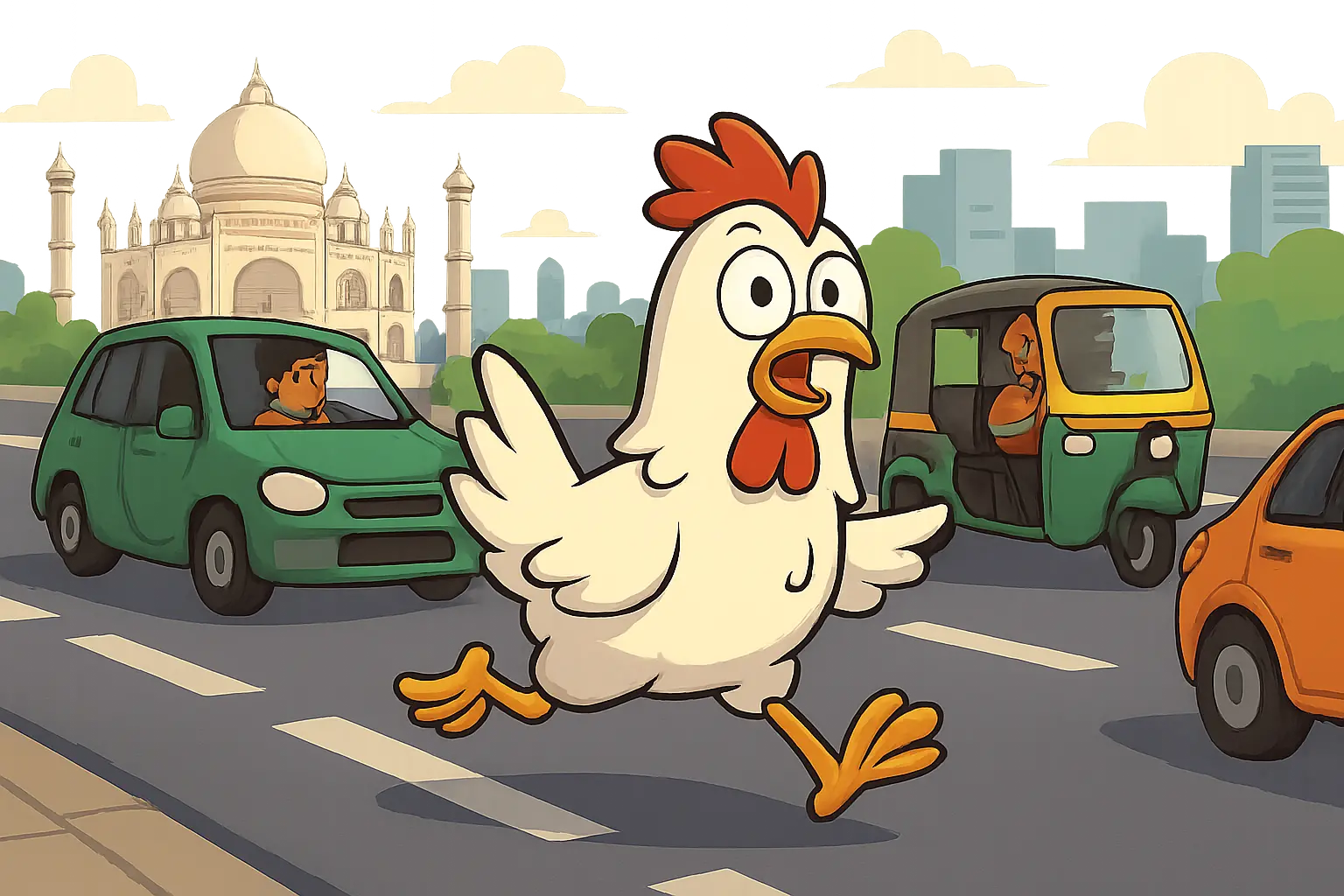
A crowded canteen, a beat-up table serving as the caster desk, two budget Android phones wired to a cheap capture card, and a dozen first-year students chanting “clutch, clutch, clutch” at a screen where a tiny character dashes between traffic and trains. The entire moment lasts about a minute, but the replay is open-loop addictive. This is the shape of casual esports in India: fast, funny, competitive, and built for creators and campus crews. If Chicken Road can compress that thrill into a reliable, fair, and streamable format, it can become India’s next casual esports hit.
The Indian audience already signals where the wind is blowing. Players love short-match mobile games that run on low-end devices, reward skillful timing, and create shareable highlights. Creators on Loco, Rooter, and YouTube turn everyday challenge runs into appointment viewing. Brands chase family-safe formats that deliver reach without controversy. Organizers want titles with stable netcode and spectator tools. And school and college clubs are hungry for new games that are easy to onboard and exciting to play in a two-minute slot. That intersection—skill, spectacle, and simplicity—is the opportunity in front of the Chicken Road game.
What Makes a Casual Game Esport-Ready?
Casual esports in India lives or dies by discoverability and repeatability. The game loop must be simple to grasp, difficult to master, and capable of supporting fair, real-time competition. The backend needs to be just as thoughtful: strong matchmaking, anti-cheat, spectator/replay support, and low-latency performance on uneven networks. A game cannot earn the “casual esports” label by vibes alone. It needs plumbing.
Short, skill-expressive loops
Chicken Road fits a genre that players instinctively understand: the “tap to cross” runner. But esportability demands more than cute chaos. The loop needs visible skill expression in about a minute.
- Micro-movement and timing: The space between cars and trains should allow deliberate risk-taking, not coin-flip luck. The right cadence of “wait, stutter step, commit” is essential. Skilled players learn to read vehicle cadence, anticipate gaps, and string momentum without overextending.
- Risk vs. reward: Esports-ready casual games create a clear ladder of risk. Safe paths exist, but aggressive lines reward players who can micro-time movement and predict lane behavior. This creates highlight moments for spectators and gives competitive players something to grind.
- Consistency with variance: No two heats should feel identical, yet the game must avoid pure randomness. Controlled randomization—spawn pools, predictable pattern families—keeps skill king while giving viewers fresh situations.
- Scalable skill ceiling: High-level techniques in this genre include diagonal flow control, edge-buffering at lane boundaries, manipulation of moving platform cycles, and split-second cancels to dodge closing windows. If Chicken Road embeds these without heavy instructions, it reaches that sweet spot of easy to learn, hard to master.
Low device and data friction
India’s casual esports audience spans flagship phones, low-RAM devices, tight data plans, and variable network quality. “Works everywhere” is not optional.
- Performance on low-end phones: A buttery frame rate, quick boot, and tiny download footprint matter. Optimizing for 2GB RAM devices and implementing adaptive quality settings should be a first-class priority.
- Lightweight netcode: Real-time PvP needs lag tolerance and input prediction that feels fair. A round should not collapse because one player briefly dips in connectivity. Hide latency spikes with forgiving collision windows at low speeds and clear desync recovery rules.
- Efficient data usage: Casual esports thrives on short, frequent sessions. Asset streaming with smart caching, minimal patch sizes, and the ability to practice offline in a solo “training” lane reduce friction.
- Accessibility by language and design: Crisp iconography, short onboarding, and localized UI in Hindi and major regional languages bring new players into the lobby faster than any ad.
Built-in competitive plumbing
Chicken Road becomes a competitive staple only when it bakes in the tournament stack from day one.
- Real-time PvP and party systems: One-on-one face-offs and four-player mini-royales are the ideal building blocks. A ready-made party queue speeds up creator customs and community friendlies.
- Ranked matchmaking and MMR/Elo: True casual esports depends on fair pairings and steady progression. Visible ranks, seasonal leaderboards, and a transparent promotion/demotion experience enable long-term investment.
- Spectator mode and replays: Tournament viability rises sharply with spectator tools, camera controls, overlays for elimination/order, and replay highlights. A simple clip creator integrated with device storage or social APIs is a creator magnet.
- Anti-cheat and integrity: Even casual tournaments unravel without credible anti-cheat. Detect speed hacks, teleports, and injected inputs; enforce server authoritative positions in PvP; record a secure match hash for dispute resolution.
- Tournament APIs and lobby codes: Streamers and TOs (tournament organizers) need quick setup. Lobby codes, score APIs, and light moderation tools (mute/report, lobby kicks) reduce operational friction.
India Market Snapshot and Player Behavior
The Indian casual esports market looks nothing like the small, slow-moving ecosystems of old. It is mobile-first, creator-led, and shaped by cultural rhythm—festivals, campus cycles, and rapid trend waves. A title that respects these realities earns disproportionate attention.
Mobile-first habits, short sessions, regional languages
A majority of Indian players discover and play entirely on mobile. They download, test, and churn faster than publishers expect. Games that prioritize “time to fun” within a minute of first launch gain an unfair advantage. That first loop must deliver a win, a laugh, or a “one more try” moment.
Language matters. A Hindi-first UI and a Hinglish social voice raise retention across the heartland. Support for Bengali, Tamil, Telugu, Marathi, and Kannada builds grassroots goodwill that paid ads struggle to replicate. Simple content like “चिकन रोड गेम इंडिया” in app store metadata and regional post captions helps discovery. Players respond to micro-celebrations too: festive skins during Diwali, local music stingers, tongue-in-cheek voice lines with desi flavor.
Creator- and streaming-led discovery on Loco, Rooter, and YouTube
India’s casual esports pulse lives in creator culture. Loco and Rooter run regular challenge nights for titles like Stumble Guys and host leagues for simple PvP games that viewers can instantly parse. YouTube shorts and reels carry highlights much farther than any banner campaign ever will.
- Creator value proposition: A tournament-friendly casual game offers pluggable custom lobbies, clip-worthy near-misses, and emotes that translate to shared jokes in chat. Streamers love formats where a lobby fills in seconds, a round resolves within a minute or two, and losers queue instantly for the next room.
- Discoverability loop: Creator bounties, fan-lobbies, and “beat the streamer” formats convert viewers to players. VODs and shorts become organic tutorials; even memes (“saste BGMI vibes for your chacha’s phone”) have marketing impact.
- Platform alignment: Loco and Rooter have a clear appetite for games with quick formats and India-first vibes. JioGames occasionally amplifies casual events on-device. Chicken Road tapping into this pipeline—especially with multilingual creator packs—would shortcut adoption.
Governance, esports vs. real-money gaming, and brand safety
A quick governance note matters here. Esports sits under a recognized sport discipline umbrella for multi-sport events in India, which provides legitimacy for competitive circuits and school/college engagement. This is distinct from real-money gaming (RMG), which falls under different regulatory scrutiny and varies by state. A casual, free-to-play, ad- or cosmetic-driven esports title keeps brand doors open. That difference is crucial for brands, campuses, and public-sector events.
For reference, see the Press Information Bureau’s notification on recognition of esports within the multi-sport event framework: https://pib.gov.in/PressReleasePage.aspx?PRID=1884961
Competitors Chicken Road Must Beat
The rival set spans direct genre peers, casual hits with proven Indian traction, and platform ecosystems that shape visibility. Chicken Road does not need to outgun midcore behemoths; it needs to out-fun them in two minutes.
Direct genre competitors
- Crossy Road (Hipster Whale): The cultural touchstone for tap-to-cross gameplay. Enormous awareness and a beloved aesthetic. Yet, it lacks built-in esports scaffolding—no official synchronous PvP, spectator tools, or tournament APIs. The opportunity for Chicken Road is to ship competitive tooling and India-first community ops out of the box, creating a clear value gap.
- Chicken Scream and “Road Cross” clones: Short-lived viral gimmicks without sticky community structure. These titles typically lack polish, anti-cheat, and live-ops depth. Chicken Road can win by delivering durable performance and events that evolve over time.
Casual games with competitive traction in India
- Stumble Guys: The template for casual-to-esports in India—short, comic chaos, thriving creator ecosystem, and heavily localized humor. Lobby codes, easy spectating, and party features made it a streaming darling. Chicken Road can learn from its creator-led tournament patterns: quick lobbies, themed events, and seasonal circuit structure.
- Ludo King: An Indian giant. While not skill-pure, it thrives as a social competitive staple with frequent tournaments and familiar gameplay. It proves that low-complexity, high-social involvement formats can sustain massive reach.
- Carrom Pool and 8 Ball Pool: Real-time PvP with clear skill expression and league structures. Tournament-friendly, sticky, and widely adopted in India. The principal lesson: competence must feel visible and controllable; performance anxiety reduces churn only if players can improve with practice.
Not formal esports, but creator-challenged favorites
- Subway Surfers, Temple Run: Marathon runners, not PvP brawlers, yet they dominate challenge-run content. Timed events, distance goals, and unique modifiers inspire creator events. They show the audience appetite for short-sprint challenges and proof-of-skill runs.
Ecosystem competitors and platforms influencing distribution
- Loco and Rooter: India-first streaming platforms hungry for creator-friendly competitive games. Great partners for pilots, mini-leagues, and clip amplification. Links: https://loco.gg/ and https://www.rooter.gg/
- WinZO, MPL: Skill and casual formats surface in these apps in rotating categories. Their business focus evolves; partnership decisions should follow current category policies. Distribution and tournament operations here can deliver scale quickly if the format aligns with their guidelines. Company links: https://www.winzogames.com/ and https://www.mpl.live/
- JioGames: Seasonal events and on-device real estate give it unique leverage. Telco-backed promotions can drive bursts of installs for games with tiny build sizes and instant-fun loops. Link: https://jiogames.com/
Midcore esports dominating mindshare
- BGMI, Free Fire MAX, Valorant: Audience magnets with spectacle and prize pools, but not in the casual lane. These titles set production values and tournament format expectations. Chicken Road must differentiate with accessibility, low device demands, and mini-matches that are fun to watch end-to-end.
Comparison snapshot: where Chicken Road can leapfrog
A compact view helps clarify the lane Chicken Road can own. The following table sums up key features that matter for “casual esports India,” benchmarking common expectations.
| Feature | Crossy Road | Stumble Guys | Ludo/Carrom/8BP | Chicken Road (target) |
|---|---|---|---|---|
| Synchronous PvP | Limited unofficial | Strong | Strong | Native 1v1 and 4P BR |
| Spectator/Replay | Minimal | Spectator in customs | Variable | Built-in spectator + replays |
| Tournament APIs | None public | Basic customs | Platform-led | Lobby codes, score API, moderation |
| India-first ops | Global-first | Strong creator ops | Strong | Hindi + regional live-ops |
| Performance on low-end | Good solo | Good | Good | Ultra-light, netcode-tuned |
| Skill expression | High solo | Medium high | High | High under pressure, visible micro-skills |
The win condition is clear. Chicken Road must fuse Crossy Road’s clarity and charm with Stumble Guys’ creator-led multiplayer scaffolding, then add India-first community operations and ultra-light performance.
Can Chicken Road Cross the Esports Chasm?
The core idea—a character darting across ever-more-chaotic lanes—is inherently watchable. Converting that into a competitive sport requires design choices that surface skill, support formats, and withstand community scrutiny.
Game design tweaks for synchronous play and skill ceiling
- Native 1v1 and four-player mini-royale: Direct duels keep the focus sharp; four-player lobbies add party chaos. Viewers can follow every elimination and cheer for clutch saves.
- Controlled randomization: Group lane patterns into families so veterans can read the situation rather than blame luck. Expose subtle tells—train horn cues, traffic light rhythm, conveyor direction changes—so the best players gain predictive advantage.
- Physics and collision clarity: Tight collision boxes, consistent hit rules, and visual feedback reduce “lag blame.” If a brush with a bumper edge is survivable at low speed but fatal at high speed, make that rule obvious.
- Obstacle variety with skill lanes: Balance simple cars and logs with occasional “skill gates”—moving platforms, timed gates, rotating barriers—so confident players can gain ground.
- Momentum retention and cancels: Allow tiny momentum carries across lane edges and introduce micro-cancel windows. Mastery emerges when players chain moves across mixed obstacles without stopping.
- Character readability: Skins are great, but readability must never be sacrificed. Spectators should immediately tell where a player is, what hazard is next, and whether a move is brave or reckless.
Tournament formats built for India’s viewing habits
- One-minute heats: Fast heats are the backbone of casual tournaments. A “best-of-three” head-to-head gives redemption arcs without dragging broadcast time.
- Creator bounty runs: Streamers post a target distance or a coin total; viewers queue up to beat it. A small prize or shoutout keeps the line moving.
- Four-player “battle royale” mini-lobbies: Top-two advance, bottom-two drop, repeat until a short final. The pacing keeps watch time strong while enabling quick rematches.
- Challenge modifiers: Weekly or festival tie-ins—night mode during festive weeks, slow-traffic weekends, or monsoon-themed slick lanes—add flavor. Modifiers should adjust difficulty without confusing new players.
- Team formats for campuses: Simple house vs. house matches, three duels per fixture, roster swaps between maps. Casters can explain the action in seconds to a new audience.
Integrity, matchmaking, and replay highlights
- Anti-cheat: A mobile casual game still attracts bad actors. Server authoritative checks for position updates, speed limits per tick, and sanity checks for teleport or fly hacks are table stakes. Flag suspicious events with a trust score and queue repeat offenders only with similarly flagged accounts.
- Matchmaking MMR/Elo: A visible tier system lowers anxiety. Players want fair fights and a path to improvement. Decay rules should be forgiving in casual ladders to encourage returns after short breaks.
- Replay and highlights: Compress the last few seconds of each elimination into an auto-generated clip. Let creators apply overlays and upload directly to shorts or reels. An in-game “Top Plays” reel—refreshed daily—turns the game into a content engine.
- Spectator camera presets: Side-scrolling chase cams, overhead tactical views, and a zipped replay showing both players’ inputs in head-to-heads help casters build narratives.
Go-to-Market in India
Building a competitive game is half the journey. Earning adoption among players, creators, and organizers requires surgical go-to-market steps that reflect local tastes, calendars, and platform dynamics.
Creators and communities: Hindi-first, regional next
- Creator onboarding kits: Provide a lightweight press kit with branding, HUD-less gameplay, and royalty-free music cues aligned with Indian tastes. Offer creator codes for cosmetic perks to build a sense of ownership.
- Microtournaments with cast-ready lobbies: Pre-configured lobbies and a “producer” panel help creators run community mini-events live. A highlight button that stamps a short replay with the streamer’s tag is rocket fuel.
- Challenges and UGC: Weekly “ghar ki challenge” posts in Hindi, Tamil, Telugu, Bengali, and Marathi with simple prompts—no-nudge runs, only-diagonals, reverse-camera sprints—encourage grassroots clips.
- Community support in Hinglish: A social voice that feels native carries farther. The tone should be playful, a little cheeky, and always celebratory of clutch plays.
Platforms: pilots with Loco, Rooter, and distribution partners
- Loco and Rooter pilots: Run season kickoffs and creator cups with an “India-first” stamp. Provide a tournament page and a mini-API for live leaderboards. The easier you make it for creators to go live, the faster events multiply. Loco: https://loco.gg/ Rooter: https://www.rooter.gg/
- WinZO/MPL evaluation: If category policies align, a curated “skill mode” could unlock distribution. Be careful with competitive rules and category positioning. WinZO: https://www.winzogames.com/ MPL: https://www.mpl.live/
- JioGames tie-ins: A “Jio minis” build or seasonal event can put Chicken Road in front of millions of devices. Keep the build size tiny and boot-to-match under a few taps. JioGames: https://jiogames.com/
College circuits, weekly ladders, and festival tie-ins
- Campus leagues: Simple to run, fun to cast, and safe for sponsors. Offer a campus toolkit: poster templates, bracket spreadsheets, streaming scenes, and a code of conduct. Eating joints and auditoriums become arenas with very little infrastructure.
- Weekly ladder seasons: Time-boxed seasons with new modifiers and cosmetics keep players returning. Seed community rivalries with lightweight divisions and promotion paths.
- Festival programming: Holi and Diwali tournaments, regional new-year specials, and city rivalry cups match cultural rhythms. Skins and emotes that nod to local styles create emotional stickiness.
Metrics That Signal “Esports-Ready”
- First-day retention: If new players come back quickly, the game’s loop communicates well at a glance.
- PvP attach rate within the first week: The share of players who try 1v1 or four-player lobbies indicates readiness for creator events.
- Average match time and variance: Consistent, bite-sized rounds are easier to schedule and cast. Aim for around a minute per heat with minimal outliers.
- Queue time and match fairness: Low queue times and balanced match results (not coin-flips) build trust in the system.
- Concurrency stability: Servers must handle spikes during creator events without stutter or rubber-banding.
- VOD views and short-form clips: The ratio of players to content pieces created reveals how “shareable” the game is.
- Device performance spread: Smooth performance on low-end devices signals broad market readiness.
- Report and dispute resolution: Fast adjudication of match disputes and visible anti-cheat actions reassure competitors.
Monetization and the Indian brand ecosystem
Casual esports monetization in India rewards non-invasive systems that celebrate identity and community rather than raw power.
- Cosmetics and identity: Regionally flavored skins, emotes, banners, and finish animations sell well when they feel like inside jokes with the community. Seasonal themes and creator collabs deepen engagement.
- Battle pass with skill missions: Keep missions aligned with mastery—timed dashes, risk runs, clean crossings—so progress feels like training, not chores.
- Ad monetization with restraint: Rewarded ads for revives in solo mode, never in ranked PvP. Smart frequency capping and culturally relevant ad partners protect trust.
- Creator codes and rev-share: Reward the ecosystem that fuels adoption. Creator codes on cosmetic purchases and event passes keep the flywheel spinning.
- Brand integrations that feel native: Snack brands, telcos, and campus festivals fit naturally. City-branded tournaments, festival-themed skins, or snack-sponsored “clutch moments” packages are easy to sell and fun to watch.
- Safe compliance posture: Keep the line bright between competitive play and real-money wagering. Clear community guidelines and prompt moderation attract family-friendly sponsors.
Practical playbook to reach “casual esports” status
A clear roadmap combines feature delivery, creator partnerships, and ops discipline.
- Closed creator alpha: Invite a handful of Indian streamers and campus club leaders to stress-test spectator mode, lobby codes, and replay tools. Iterate quickly on obvious friction points.
- Soft launch in India: Ship Hindi-first and add key regional languages early. Run small prize-free ladder seasons to tune MMR and matchmaking queues.
- Creator-led pilot tournaments: Co-run mini-cups on Loco and Rooter. Observe format pacing and downtime, refine camera presets, and polish overlays that highlight close calls.
- Seasonal launch with festival tie-in: Time the first big season with a high-attention cultural moment. Erect leaderboards, roll out creator skins, and run a campus invitational.
- Live-ops heartbeat: Weekly modifiers, monthly creator cups, and seasonal finals. Stability, novelty, and predictability form the triad that keeps casual esports communities engaged.
Tactical skill depth and strategy: how competitive play looks
The best casual esports titles reward players who see the matrix inside the chaos. Chicken Road can create that magic with layers of subtle mastery. A few concrete skill arcs illustrate the idea.
- Lane reading: Beginners wait for obvious gaps; advanced players sense traffic cadence. If cars spawn in triplets with a repeating micro-delay, top players pre-move into “ghost space” that will open by the time they arrive.
- Edge buffering: The boundary between lanes often allows tiny buffer zones that reset collision states. Skilled players tap into that safety window to slip through tight squeezes.
- Momentum control: A small forward bias lets confident players carry motion through transitions. The trick lies in shedding just enough speed to avoid fatal impacts while preserving a chain of crosses that cut seconds.
- Diagonal threading: Moving diagonally across mixed-speed lanes can line up multiple gaps in a single motion, a high-risk tactic that yields distance spikes when read correctly.
- Cycle manipulation: Obstacle cycles—moving logs, rotating gates—often respond to proximity. Top players learn “cycle seeding” by entering a lane at times that cause favorable patterns downstream.
- View discipline: Keeping the eyes one lane ahead separates good from great. A narrow focus on the immediate hazard leads to panic stops; a broader scan enables planned aggression.
- Adaptation to modifiers: Night mode reduces peripheral cues; slow-traffic weekends reward patience; slick lanes punish over-committing. Competitive players drill these modes to preserve fundamentals under altered physics.
Technical architecture for low-end phones and uneven networks
Casual esports engineering in India starts with realism about devices and connectivity. Beauty always follows usability.
- Adaptive frame budget: Target steady, readable motion on low-RAM devices by scaling particle effects and background detail. Maintain consistent hit detection across quality tiers.
- Input predict-and-correct: Client-side prediction ensures responsive feels, while server reconciliation guards against unfair advantage. Small latency windows can be absorbed by forgiving collision grace at low velocity.
- Snapshot-based sync for spectator: Spectator streams should receive state deltas at modest frequency, interpolating locally for smoothness while respecting authoritative positions.
- Net stability under spikes: Creator events produce bursts in concurrent sessions. Single-tenant match servers or reserved instance pools protect against stutter during peak windows.
- Asset streaming and offline training: Keep the core loop playable even if a patch fails mid-download. Solo training lanes let players practice without data anxiety.
- Telemetry for fairness and tuning: Instrument every elimination and near-miss. Surface borderline collisions to designers for hitbox tuning. Track desync rates per device and network type.
- Anti-cheat SDK integration: Hook into platform-level secure input APIs when available, sign replays, and store match hashes for disputes. Server-side sanity checks remain the final arbiter.
Mini case study: why Stumble Guys-style events work in India
Watching a dozen college friends stream a party lobby illustrates the formula. A lobby fills instantly because the room code sits on screen. The round ends in under two minutes, so everyone sees a resolution before attention drifts. The physics are silly enough to generate laughs, but the top players still show dependable skill. Crucially, the platform makes it straightforward to spectate and clip. That combination—fast, social, climactic, and clippable—is the blueprint Chicken Road should pursue. The difference lies in spotlighting micro-movement skill rather than ragdoll chaos, which actually suits Indian skill-centric audiences and brand sensibilities just as well.
Community operations: India-first or bust
Casual esports lives in community cadence. Go light on global polish and heavy on local heartbeat.
- Regional celebration: Announce winners in Hindi and regional languages. Feature top creators from North, West, South, and East with equitable rotation. Celebrate local duels—Chennai vs. Kolkata, Pune vs. Ahmedabad—in ways that feel playful, not hostile.
- Creator feedback loop: Surface what creators want on a simple form; triage requests into fast wins (lobby quality-of-life), medium wins (additional spectator camera angles), and longer-term features (new ranked divisions).
- Trust and safety: Clear moderation tools for custom lobbies and rapid report actions keep families and colleges onboard. A gentle tone in ban communications protects goodwill.
- School and college clubs: Offer free “tournament in a box” kits—rules, overlays, bracket templates—to event committees. A line on the website for “college partner” contact makes it easy to jump in.
SEO, discoverability, and the India search graph
Finding the audience at scale means speaking their language in app store listings, social posts, and creator titles.
- Organic keywords that match intent: “Chicken Road multiplayer India,” “casual esports India,” “best 1v1 mobile games India,” “low-end phone esports games,” “short match esports games,” and Hinglish counts like “कैज़ुअल ईस्पोर्ट्स गेम्स इंडिया” draw in curious players. Use these terms naturally in store descriptions and video titles rather than stuffing them.
- Localized store assets: Screenshots with Hindi and regional copy, a trailer that shows synchronous play and a nail-biter finish, and a short bullet list focused on “fast matches, real-time PvP, spectator mode” cue tournament readiness.
- Creator SEO: Provide tags for creators—“Chicken Road tips and tricks,” “matchmaking Elo MMR explained,” “Chicken Road tournament format”—embedded into official guides and blog posts.
- Platform partners’ pages: Loco and Rooter event pages act like search beacons. Align event names with the same phrases players punch into search boxes.
External reading and signals for authority
- Government recognition context: https://pib.gov.in/PressReleasePage.aspx?PRID=1884961
- Loco platform: https://loco.gg/
- Rooter platform: https://www.rooter.gg/
- AFK Gaming coverage for India esports ecosystem: https://afkgaming.com/
These links help ground Chicken Road’s positioning within India’s formal and creator ecosystems.
Chicken Road vs. the field: positioning statements
- Against Crossy Road: Chicken Road aims to be the esports-native take on the tap-to-cross fantasy. The differentiator lies in synchronous PvP, spectator-first design, and India-first community operations.
- Against Stumble Guys: The pitch is a tighter skill canvas with comparable streamability. Less slapstick, more surgical. Matches remain laugh-worthy, but a trained eye can appreciate micro-skill under pressure.
- Against Ludo/Carrom/8 Ball Pool: Chicken Road brings visceral, second-to-second decision-making instead of turn-based or cue-angle calculations, widening the entertainment funnel for spectators who want instant stakes.
- Against Subway Surfers/Temple Run: Chicken Road evolves the “endless runner” energy into direct competition with elimination drama, making it inherently league-friendly.
Roadblocks to anticipate and how to clear them
- Perception as “just another Crossy clone”: Counter this with competitive features, ranked ladders, and streamer-facing tooling. The competitive plumbing is the message.
- Cheating fears: Publish an integrity charter, explain server checks, and commit to visible enforcement. Post monthly anti-cheat updates even when nothing dramatic happens.
- Device fragmentation: Ship adaptive performance profiles from day one. Showcase low-end device gameplay in trailers and creator videos to prove it.
- Content drought: Build a content pipeline with weekly modifiers, monthly “skill maps,” and seasonal cosmetics to keep the meta fresh.
- Tournament fatigue: Rotate formats. Alternate head-to-head duels, four-player BR nights, and quirky community challenges. Use short series with snackable finals.
How play feels to a spectator
A good spectator experience lets viewers read the stakes without a rulebook. The hazard cadence should telegraph difficulty spikes; the camera must never lose the player at the center of drama. Shoutcasters get vocal anchors—“safe lane on the left, squeezer on the right, train cycle due”—to build narratives. Elimination stingers and instant slow-mo on near-misses make clips irresistible. Because each round ends quickly, new viewers drop in and immediately see closure, then stick around for the next run.
Live-ops that keep the flame alive
- Seasonal themes that acknowledge Indian calendars: A monsoon season with slick lanes and wiper-themed cosmetics; a festival season with lantern trails and celebratory emotes.
- Skill tracks inside the pass: Players progress not by grindy chores but by milestones that reflect real improvement—survive multiple train cycles, perfect a diagonal chain, clear a hazard without stopping.
- Creator collabs: Limited-time lobbies branded to popular streamers with unique banners or voice lines. Revenue share sweetens the pot.
- Community spotlights: A rotating carousel of player clips and campus tournament recaps builds FOMO and normalizes competitive entry.
- Fairness audits and patch notes: Regular tuning for obstacle fairness and hitboxes builds trust. Explain changes with simple gifs or short videos.
A blueprint for campus and community TOs
Tournament organizers at the college and local-club level appreciate predictability and ease.
- Match formats: One-minute heats in best-of-three sets for duels; four-player lobbies with top-two advancing for mini-brackets.
- Tools: Lobby codes, match history with hashes, player MMR snapshots for seeding, and a minimal moderator panel.
- Broadcast kit: Default overlays, a player order widget, and an elimination timeline integrate with OBS without heavy setup.
- Sponsor placements: Lower-third zones for local sponsors and a “clutch moment” brand stinger that triggers on close calls.
- Codes of conduct: A simple document covering language, disconnect rules, and behavior. Easy to print, easy to enforce.
Design guardrails to keep it casual and competitive
- No pay-to-win: Cosmetics only. Keep collision boxes, movement speed, and camera FOV identical across skins.
- Clear readability: Saturated color palettes, clean lane edges, and distinct hazard silhouettes ensure split-second decisions remain possible on small screens.
- Gentle onboarding: A two-step tutorial that teaches wait vs. commit, diagonal threading, and safe stoppage is enough. Players should be tournament-ready by the end of their first session.
- Audio cues that help with skill: Train horns, tickers for rotating hazards, and different honks by vehicle speed give subtle mastery tools without text.
- Cross-input parity: Touch and controller inputs should feel equitable if controller support exists. In ranked, standardize input windows to avoid unfair advantage.
The brand story and cultural fit
Chicken Road has an inherently family-friendly fantasy—taking a brave little character across bustling lanes and hazardous platforms. Indian audiences instantly recognize the humor in chaotic traffic, but they also respect skillful navigation. Lean into this duality. Nudge the tone toward playful, not slapstick; awe at precise movement, not merely at outrageous mishaps. A brand that celebrates mindful risk-taking aligns with campus values, parent comfort, and sponsor expectations.
Discovery content that works
Publish official “Chicken Road tips and tricks” videos that highlight real skill-building: lane reading, diagonal chains, and momentum management. Post short clips demonstrating fair saves and explain why a collision was valid or avoidable. A “matchmaking and ranking explained” blog demystifies MMR/Elo for casual audiences. For deeper coverage, an “obstacles guide” breaks down hazard families with counterplay notes. Each piece should be shareable and concise, the kind of link a streamer drops in chat when chat floods with “how did you do that.”
The verdict: the path for Chicken Road to become India’s next casual esport
The opportunity is real. India’s casual esports audience already rewards the qualities Chicken Road can embody: lightning-fast matches, visible skill under pressure, creator-friendly lobbies, and community-first live-ops. The competitor landscape is strong but not insurmountable. Crossy Road commands nostalgia without competitive scaffolding. Stumble Guys proved the pipeline from party chaos to creator circuits. Ludo King and Carrom Pool demonstrate appetite for simple, social, tournament-ready play. None of them occupy the precise lane Chicken Road can claim: a tap-to-cross skill arena purpose-built for one-minute duels and four-player elimination lobbies, tuned for low-end phones, and localized for India from day zero.
Winning requires discipline. Ship synchronous PvP with server-authoritative checks. Polish spectator tools and instant replays that make highlights trivial to share. Invest in Hindi-first and regional support for UI, social copy, and caster kits. Court creators with lobby codes, bounty formats, and revenue shares. Embed campus circuits and festival events into the beat of the year. Measure what matters—match length, fairness, queue times, device performance—and iterate visibly and often.
Do that, and the Chicken Road game moves beyond clone comparisons into a future where “Chicken Road esports” becomes shorthand for India’s favorite two-minute showdown. A little bird can, in fact, lead a big movement—if it crosses with confidence, skill, and a camera pointed in the right direction.
Key answers for players, creators, and organizers
- Multiplayer modes suited for tournaments: Native 1v1 duels and four-player mini-royales with spectator support deliver the right balance of pace and clarity. Party systems should let creators fill lobbies instantly.
- Ideal match length: About a minute per heat keeps broadcasts crisp and queues short, with best-of-three sets providing narrative arcs without fatigue.
- Platforms ready to host: Loco and Rooter are natural homes for creator-led cups and mini-leagues. WinZO and MPL can amplify distribution if category fit is confirmed. JioGames can supply bursts via device-level promotions.
- Devices and networks to support smoothly: Low-RAM Android phones and variable 4G conditions remain the baseline. Adaptive performance profiles, input prediction, and server reconciliation keep matches fair and responsive.
- Cheating prevention essentials: Server-authoritative movement, speed and teleport checks, secure replay hashes, and a visible enforcement policy safeguard competitive integrity.
Internal notes for continued learning
For extended perspectives, explore our earlier analysis on India’s casual esports adoption curve for mobile-first audiences at /india-casual-esports-guide, and a deeper live-ops playbook for seasonal casual games at /casual-game-live-ops-playbook. These resources map directly onto Chicken Road’s path from fun runner to staple esport.
Alt text cues for imagery in coverage
- Chicken Road multiplayer casual esports India
- Crossy Road competitor India
- Casual esports games India in Hindi
- Low-end phone esports games
If the team behind Chicken Road anchors design and operations to the realities of the Indian market, the rest will follow: creators will fill lobbies, colleges will run brackets, and short clips will flood feeds. The magic of casual esports lies in giving millions a reason to cheer in the time it takes to boil chai. Chicken Road can deliver that magic—reliably, fairly, and in a language that India already speaks.
