` tags and any ` ` tags that immediately follow them, we will use a two-step regular expression replacement process. This ensures that only the `
` tag is removed if no ` ` follows, and both are removed if a ` ` is present right after the `
`. This approach preserves other surrounding whitespace (like newlines for formatting) that don’t contribute to the ‘unnecessary offset’ caused by the heading and explicit line breaks.Here’s the processed code:“`html
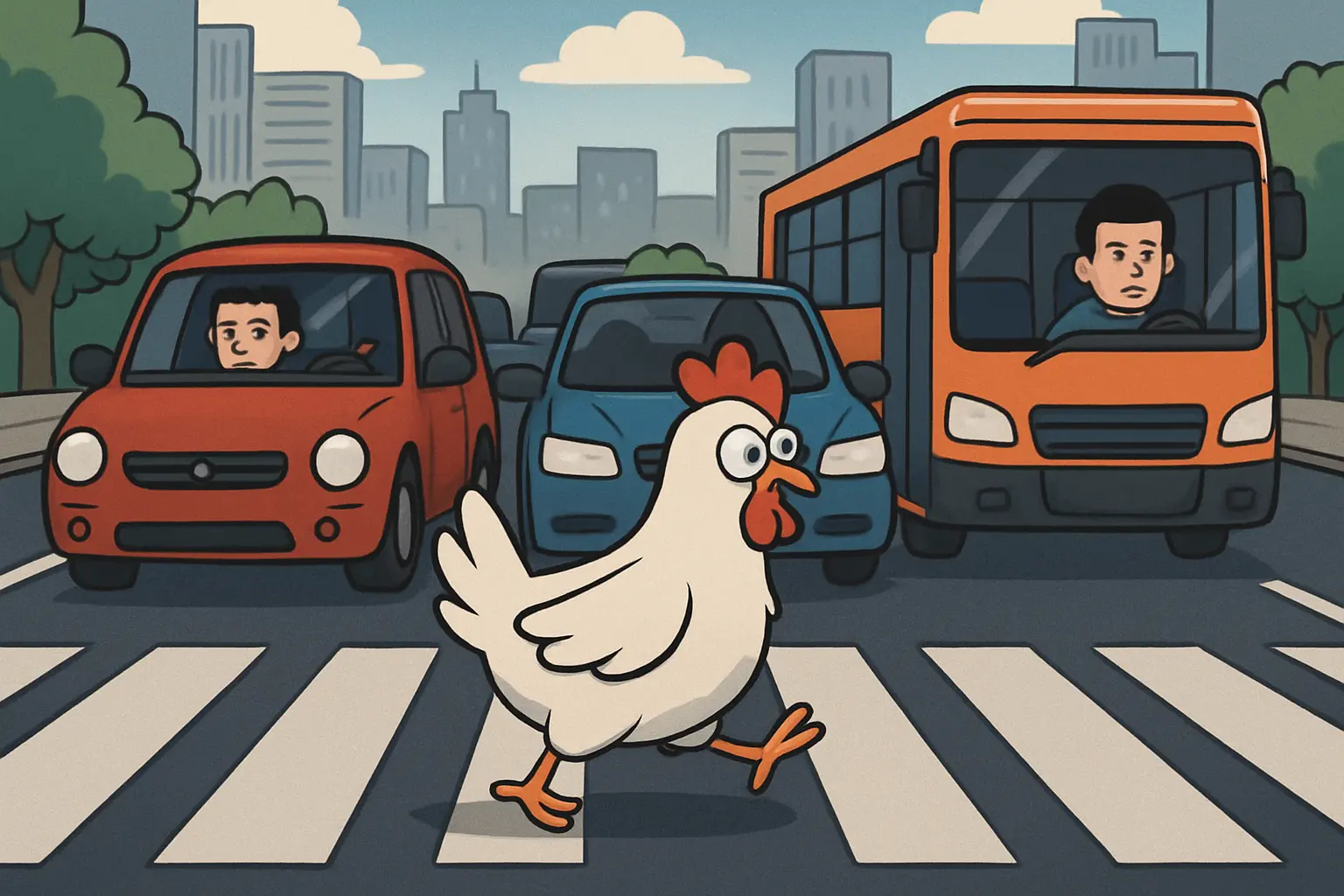
The first time I watched a kid play Chicken Road, I felt the tug of two worlds colliding. On the screen, a cartoon bird darted between cars, paused at the edge of a lane, and sprinted across a river on floating logs. Offscreen, my head went straight to the crosswalk where I’d spent the afternoon measuring driver yielding rates and timing the gaps that people were willing to accept. The patterns matched. The only difference: the game resets when you lose. Real life doesn’t.
Chicken Road—like its cousins Crossy Road and Frogger—distills urban movement into a few precise choices: move now or wait, change lanes or stay put, gamble for points or play it safe. Those choices echo exactly what pedestrians, cyclists, and drivers weigh on a city street, from downtown scramble crossings to midblock dashes on wide arterials. If you want to understand why traffic jams form “for no reason,” why a leading pedestrian interval changes everything, or why a refuge island might be the most important square of concrete in a neighborhood, this deceptively simple genre offers a compact, oddly honest model.
As a transportation reporter turned practitioner, I’ve spent months watching intersections from a folding chair, counting head turns and brake lights, sketching desire lines with chalk, and running quick simulations to test signal timing. Chicken Road has become one of my favorite metaphors for explaining what games teach us about traffic flow and congestion, and how good design converts risky behavior into predictable, safer movement. Let’s walk through the mechanics, then step into the street.
The Road-Crossing Game That Mirrors the Street Outside
There’s a reason these games stick. They bottle two universal truths:
The street is a negotiation among many actors.
Small timing errors compound.
In Chicken Road, the player scans for gaps, estimates speed, edges forward, retreats, and occasionally takes a leap of faith. In a city, pedestrians do the same thing—often with far more on the line. A person at the curb does not wait for a timer; they wait for a gap that meets their threshold of comfort, a threshold that shifts with speed, visibility, lighting, and urgency.
Watch long enough and you’ll see distinct personas emerge in both spaces: the cautious crosser waiting through multiple cycles; the opportunist threading through two tight vehicles; the rule follower hitting the button and standing stock-still; the improviser crossing midblock where the desire line is shortest. Good design accommodates the human spectrum without demanding perfection from any one person. That’s the Safe System Approach in a sentence.
Game mechanics → traffic behavior
Gap acceptance is the beating heart of a road-crossing game and real-world crossing decision-making. In the game, you learn it intuitively: how long until that truck reaches you, what speed is safe, how much buffer you want before stepping off the curb. In the field, we measure it. Gap acceptance in traffic is the minimum time headway—or spatial gap—a pedestrian or driver deems acceptable to complete a movement. It varies by individual, by context, by the consequences they perceive.
In Chicken Road, you learn that when speeds are high, you wait for longer gaps or you don’t make it.
In the street, rising vehicle speeds reduce the number of acceptable gaps and push people to cross in clusters—an effect you can detect in near-miss data and on video.
Reaction time and traffic
Games drill reaction time. A player reacts to a new obstacle within a fraction of a second. On the road, reaction times stack: the pedestrian steps out; the first driver perceives, interprets, and brakes; the driver behind reacts to the brake lights; a wave of deceleration passes upstream. That’s how a simple crossing can trigger a small shockwave. I’ve filmed these waves on slight downhill sections where drivers over-brake and then accelerate to “catch up,” exactly like the game’s shuddering movement lines.
Risk-taking behavior pedestrians
The “one more lane” impulse is familiar to anyone who’s played. Real pedestrians do it when the far lane looks clear or when standing between lanes feels more dangerous than moving. Research in pedestrian gap acceptance finds that two-stage crossings—crossing to a median or refuge—reduce risky “two-lane sprints” by splitting the decision into two manageable parts. The game naturally pushes you to look for those safe islands; the street should offer them on purpose.
Lane-by-lane speed variance
Chicken Road is unforgiving about speed variance. A slow lane next to a fast lane generates tricky misperceptions and late decisions. On a real street, speed variance is a predictor of conflicts. If one lane is stopped and the adjacent lane is moving, the moving driver may not see the pedestrian emerging. That’s a classic setup for a multiple-threat crash—one vehicle yields, the other overtakes and strikes. You’ll see this dynamic at multi-lane arterials without refuge islands, or at staggered stops. The game bakes it in; engineering can design it out.
What games teach us about traffic flow and congestion
Beyond the crossing, road-crossing games feel like miniature traffic simulators. The cars in Chicken Road thrum in platoons; they bunch, release, and bunch again. That’s traffic flow theory, stripped to its essentials.
The fundamental diagram of traffic flow
Imagine three axes: flow (vehicles per unit time), density (vehicles per distance), and speed. At low density, speed is high but flow is modest because few vehicles are present. As density rises, flow increases to a maximum—road capacity. Push beyond that, and speed collapses, flow drops, and you enter unstable conditions. This rise and fall is the fundamental diagram of traffic flow. In the game, when too many cars flood a lane, the safe gaps disappear; progress stalls or becomes risky. In real traffic, the same logic dictates how quickly a freeway segment can process vehicles; it’s why ramp metering and speed management help hold flow near the sweet spot.
Shockwave traffic jam and stop-and-go waves explained
Shockwaves are moving boundaries in traffic: a transition between states (free flow to congestion, or vice versa) that propagates backward through a queue. You see it when a driver taps the brakes on a curve, and five minutes later cars miles behind slow for “no reason.” The disturbance travels upstream. In Chicken Road terms: a tiny pause to avoid a log cascades into a wave of stopped cars that sweeps across the screen.
Alt text: stop-and-go traffic wave diagram showing a backward-moving wave of congestion as vehicles compress, then expand.
A few simple truths emerge:
Smooth, predictable speeds damp waves.
Sudden lane changes and late braking amplify waves.
Minor disturbances can cause major delays in dense traffic.
Zipper merge benefits
Zipper merging is one of the rare tactics that feels counterintuitive in a game and vital on a highway. The idea is simple: use both lanes fully, then alternate at the merge point—like a zipper. This pattern minimizes disruptions to the speed field and preserves capacity. Early merging creates long underused lanes, bigger speed differentials, and more turbulence. In simulation, the cellular automata rules that allow frictionless late merges reduce shockwaves.
Small comparison table: merge strategies
Strategy
Where it shows up
Typical effect
Early merge
Long advance signs, nervous drivers move over early
Lane-changing behavior models and cellular automata
Many traffic models reduce drivers to a set of rules—if the gap in the adjacent lane is above a threshold, consider a lane change; if the difference in speed exceeds a trigger, brake proportionally. Cellular automata traffic models, the simplest of which divide the road into cells that are either occupied or empty, reproduce most of the patterns you see in Chicken Road: jam formation, stop-and-go movement, and the emergence of platoons. If you’re teaching STEM, a few lines of code can simulate a shockwave with surprising accuracy.
Queueing theory traffic basics
Queueing theory helps decode intersections. Each approach lane is a server with a service rate set by the green time, saturation flow, and lost time. Arrivals are stochastic; if the average arrival rate exceeds the service rate for long enough, the queue grows and spills back into upstream nodes. In the game, when a train passes, everything stops; when it clears, the queue discharges at a stable rate, then vehicles spread out again. The math behind that discharge rate is the same math that tells you how long pedestrians will wait if the walk phase comes late in the cycle.
Crossy Road lessons for traffic and pedestrian safety
Let’s be direct. The best “crossy road traffic lessons” aren’t about reflexes. They’re about design that reduces the need for them. There are, however, habits from the game that map to “road-crossing game safety tips,” especially for kids:
Face the lane you’ll cross first. It’s astonishing how often we see people step into a street while looking the other way. In the game, that’s a quick loss. On the street, it’s a common root cause of conflicts.
Cross in stages when the street is wide. Two short, clear movements beat a long, uncertain sprint.
Avoid moving vehicles’ blind spots. Buses, trucks, and SUVs create shadow zones. In the game you can see everything; in life, you can’t.
If you’re unsure of a gap, wait. The perceived cost of waiting can feel high; the real cost of misjudging is far higher.
Hazard perception and driver yielding behavior
In field studies, we watch whether drivers yield to pedestrians waiting at the curb, already in the crosswalk, or in the lane. The rates change dramatically with visibility and speed. High-visibility crosswalk markings, better lighting, and advance yield lines move the needle. A leading pedestrian interval (more on this soon) increases yielding too, because it places people out in front where drivers cannot miss them.
What games teach about traffic flow informs safety: smooth speeds protect everyone, and predictable movement creates clarity. When we combine speed management with crossing design, we tame the chaos that the game dramatizes.
From Frogger-style crossing to design that forgives
Chicken Road and Frogger are glamorous versions of a daily reality for millions of people: you need to get across. The design toolkit to make that safe and simple is mature. We should use it.
Pedestrian refuge island benefits
Refuge islands, placed midblock or in the median, split wide crossings into two simpler steps. They increase perceived safety, reduce required gap size, and help older adults and children, who often have slower walking speeds or more conservative gap acceptance. If an island is raised and protected, it becomes a waiting zone. Even a painted or modular refuge, coupled with vertical elements, changes behavior. In Chicken Road, the lily pad is a refuge; in cities, it’s the triangle of concrete that can save a life.
Alt text: plan-view sketch of a pedestrian refuge island with a cut-through aligned with the crosswalk and detectable warning surfaces.
Leading pedestrian interval (LPI)
An LPI gives pedestrians a head start—typically a few seconds—before parallel vehicle movements begin. This simple step changes the geometry of conflicts. When people enter the crosswalk first, they occupy the space and become visible before right-turning drivers move. It reduces conflicts at the corner, increases driver yielding, and clarifies priority. In the game, think of it as freezing the cars for a moment so the chicken can step onto the first tile; once you’re out front, drivers move around you, not through you.
Scramble crosswalk (diagonal crossing) pros and cons
A pedestrian scramble—sometimes called an all-walk or Barnes dance—stops all vehicles on all approaches and lets people cross in every direction, including diagonally. In the right context—dense walking demand, tight downtown grid, heavy turning movements—the scramble aligns with the desire lines and reduces conflicts. It shines near transit hubs and campuses where corner crowding is intense. But scrambles extend cycle length and increase delay for vehicles and sometimes pedestrians if they reduce walk frequency. The design challenge is balancing phase length, progression, and context.
Alt text: diagram of a scramble crosswalk phase with diagonal paths connecting all corners while vehicular movements are red.
Midblock crossings: when to add
People don’t cross where it’s convenient for cars; they cross where it’s convenient for them. Midblock crossings, marked and often signalized, answer desire lines where blocks are long or land uses are offset from corners. With a refuge island and speed management, midblock crossings can be safer than forcing a two-block detour to a nominally “safer” location that few will actually use. The game’s lesson is blunt: players go where the points are; pedestrians go where their lives are.
Curb extensions, bulb-outs, and daylighting
Curb extensions tighten the radius at intersections, shorten crossing distance, and prevent illegal parking at the corners. Daylighting—keeping the space at the approach to the crosswalk clear of parked vehicles—improves sight lines for both drivers and pedestrians. Together these measures reduce turning speeds and increase visibility. In Chicken Road terms: widening the safe stepping stones while slowing the fastest lanes.
Narrow lanes, speed management, road diets, and safety outcomes
Narrowing lanes—within safe design ranges—reduces operating speeds without sacrificing capacity at urban speeds. Road diets convert excess vehicle lanes into space for medians, bike lanes, or parking, and they tend to reduce injury crashes by promoting lower speeds and fewer conflict points. Where volumes don’t require four lanes, a three-lane configuration with a center turn lane plus refuge islands often balances efficiency and safety. Speed management on urban streets is the foundation; everything else builds on it.
Complete Streets crosswalks
Complete Streets policies are the institution-level commitment to design for everyone. On the ground, that means marked crosswalks with clear legibility, lighting that illuminates people not just pavement, signal timing that reflects human walking speeds, and intersections scaled to neighborhood context. The design goal is consistency: when your eyes and body tell the same story as the signs, behavior falls into line.
How to design safer crosswalks: treatments at a glance
Treatment
Where it fits
Primary effect
Notes
High-visibility crosswalk (zebra or ladder)
Urban intersections, midblock
Improves driver detection and yielding
Pair with advance yield lines on multi-lane roads
Pedestrian refuge island
Wide multi-lane arterials, midblock
Splits crossing into two stages, lowers gap requirement
Use vertical elements for presence; align with desire lines
Urban design and policy: Vision Zero and the Safe System Approach
Vision Zero is a promise: no loss of life is acceptable. The Safe System Approach is how you keep that promise. It recognizes that people make mistakes and that systems must be forgiving. In practice, that means designing streets where the forces in a crash are survivable, where redundancy in controls compensates for human fallibility, and where data—including near-miss analysis—guides investment.
NACTO provides design guides that translate this philosophy into curb radii, crosswalk markings, lane widths, and signal strategies suited to streets, not freeways.
FHWA offers a deep library of countermeasures, from LPIs and RRFBs to road diets and median refuges, supported by empirical evaluations.
TRB—through its panels and publications—pushes the research frontier: refining the fundamental diagram for mixed traffic with micromobility, calibrating lane-changing models, or investigating how LPIs affect yielding behavior over time.
Safe System thinking is game thinking with stakes: design out single points of failure. Don’t rely on the player to make a perfect move every time. Build layers that prevent catastrophic outcomes even when someone hesitates, misreads, or simply trips on the curb.
Human factors and psychology on the crosswalk
Risk compensation
People adjust their behavior based on perceived risk. Add a pedestrian countdown signal and some folks may start sprinting at the last second; add a median island and others may be more willing to attempt a crossing. This isn’t a reason to avoid safety improvements; it’s a reminder to design for the net effect. Road diets, for example, may increase comfort for pedestrians and cyclists and reduce vehicle speeds—a double win—even if drivers feel “safe enough” to glance at their phones more than they should. The Safe System Approach assumes imperfection and still improves outcomes.
Inattentional blindness and hazard perception
Drivers can look and not see. Inattentional blindness happens when attention is consumed by a task—like searching for a street number or watching the signal—while an unexpected object, a person in dark clothing for example, goes unnoticed. For pedestrians, hazard perception improves with experience; kids scan less effectively and judge speeds poorly, especially at higher speeds. That’s why school-area designs emphasize short crossings, lower speeds, and conspicuous markings. In the game, every obstacle is high-contrast; on the street, we must create that contrast with lighting and design.
Eye contact and yielding rates
Eye contact is powerful but unreliable. In the field, we track yielding rates with and without an explicit glance between pedestrian and driver. A quick eye lock can change behavior, but it’s not a systemic safety tool. Design that compels slowing and makes the pedestrian visible does more. LPIs, curb extensions, and lighting beat a nod every time. Still, teaching pedestrians to establish presence—stepping to the edge, facing traffic—raises the odds that drivers will yield.
Crossing decision-making and attention
Phones complicate everything. Attention and distraction at crossings matter as much for pedestrians as for drivers. A person engrossed in a screen has slower gap acceptance processing, and their body language becomes ambiguous, making it harder for drivers to predict intent. Engineering can’t fix human attention, but it can buy time and space: longer walk intervals, shorter distances, clearer sight lines.
Tech and future mobility
Autonomous vehicles and pedestrian interaction
AVs promise perfect attention and consistent adherence to rules. But predictability cuts both ways. If people learn that AVs always yield, some will step out more aggressively, counting on deference. The right balance—clear cues, external displays, consistent speed profiles approaching crosswalks—will be crucial. We’re already testing pedestrian-to-vehicle communication (V2X) concepts: devices that broadcast a person’s presence to nearby vehicles or signals. The key is to avoid designing for technology first; the curb should still tell the truth even if every car becomes a robot.
AVs and crosswalks safety lives and dies on three pillars:
Detection and classification of vulnerable road users with computer vision, especially in cluttered, mixed lighting conditions.
Behavior planning that handles ambiguity at unprotected crossings, including midblock.
Interaction design that communicates intent to humans without relying on easily missed signals.
Computer vision near-miss detection
Near-miss analysis is transforming safety work. Instead of waiting for crashes, cities and researchers are using camera analytics to detect close calls—events with short time-to-collision—by tracking movements in real time. These data, anonymized and parsed, highlight risky geometries and times of day. In a few days of capture you can identify conflict hotspots that would take years of crash data to reveal. Apply the fix, then rescan; the feedback loop shrinks from months to weeks.
Smart signals and adaptive timing
Smart signals detect pedestrians lingering on the island, extend walk times when a person moves slowly, or advance a walk when demand peaks. Adaptive signal timing for pedestrians is the human parallel to transit signal priority. Combined with LPIs and scrambles, these systems tune the intersection to how people actually move. The goal is not to maximize vehicle throughput regardless of context; it’s to optimize for safety and sustainable mobility.
Micromobility at crossings safety
E-scooters and bikes accelerate quickly and can appear suddenly at crosswalks, sometimes riding through when they should dismount, sometimes acting as vehicles in a crosswalk space not designed for their speed. Designs that separate movement by speed, give bikes clear priority lines, and provide bike boxes at signals reduce uncertainty. In Chicken Road terms, imagine a lane of scooters slicing between cars; you’d change your strategy. Streets should set the rules of engagement so no one needs to guess.
Education, classrooms, and outreach
Game-based learning for traffic safety and urban planning
The bridge between Chicken Road and the classroom is natural. A short module on gap acceptance, combined with a few rounds of the game, gives students an intuitive base—then you layer in the math. Ask them to stand at a quiet crosswalk and time gaps for five minutes. Compare those observations to their in-game comfort thresholds. Discuss how lighting, speed, and lane count change the picture. In my workshops, that simple loop turns abstract terms into lived knowledge.
Traffic safety lesson plans
An effective classroom traffic simulation activity can be sketched in an afternoon:
Map a simple two-lane road on the floor with tape. Use colored blocks as vehicles and students as pedestrians.
Assign reaction times by giving drivers a “beat” count before they can respond to a pedestrian stepping off the curb.
Vary speeds by lane, then add a refuge island. Measure how many successful crossings occur in five minutes under each configuration.
Add a leading pedestrian interval by freezing vehicle movement for, say, two beats while pedestrians enter the crosswalk.
Debrief: Which design produced the smoothest flow and the fewest near-misses?
Simulate traffic waves with cellular automata
For older students or professionals, a simple Python notebook can simulate a one-lane road using a cellular automaton:
Represent the road as a list of cells, each either empty or containing a vehicle with a speed attribute.
Each time step, accelerate vehicles up to a max unless a vehicle ahead is too close; then decelerate.
Randomly apply a small probability of braking to introduce variability.
Plot the positions over time; the stop-and-go waves emerge without any incident.
That exercise demonstrates the fragility of flow and why gentle, consistent speeds outperform aggressive accelerations.
Reinforcement learning and the crossing game
You can even introduce reinforcement learning: train a virtual “pedestrian” agent in a gridworld with moving obstacles to maximize reward (crossing safely) while minimizing penalties (waiting too long). You’ll find the agent “discovers” LPIs when you add a state where traffic pauses, and it “prefers” refuge islands when the environment offers them. Students connect the algorithm’s behavior to real design implications.
Practical how-to: designing better crossings, step by step
If you’re looking for a compact, field-proven sequence rooted in a safe system approach and informed by crossy road traffic lessons:
Start with speed management. Align posted and operating speeds with urban context. Use lane narrowing, vertical deflection where appropriate, and signal progression set for safe speeds.
Map desire lines. Observe where people already cross, not where you wish they would. If a midblock crossing aligns with land use, evaluate and design it rather than policing it away.
Right-size the crosswalk. Choose high-visibility markings. If the road is wide, add a refuge island. If turning volumes are high, consider an LPI. If pedestrian volumes are very high with frequent turning conflicts, evaluate a scramble crosswalk.
Clear the sight lines. Daylight the approach to the crosswalk. Install curb extensions to shorten distance and slow turning vehicles.
Illuminate people, not just pavement. Place lighting to reduce contrast between a pedestrian and the background; ensure vertical illuminance at the crosswalk.
Tune the signal plan. Introduce LPIs where right turns on green are common. Adjust pedestrian clearance times to reflect observed walking speeds. Consider adaptive timing or demand-responsive activation.
Enforce through design. Use physical elements to reinforce rules—curbing to prevent corner parking, vertical posts near islands, colored surfacing for bike priority areas.
Measure what matters. Add near-miss analysis where possible. Track yielding rates and pedestrian delay. Iterate.
Frogger-style crossing and real-world traffic behavior
When you ask a crowd about Frogger, someone will inevitably mention the thrill of a narrowly avoided hit. That thrill is exactly what we have to design out of real streets. Humans seek efficiency; they aim for desire lines; they respond to cues. If the geometry invites a dash, dashes will happen. If the system offers a calm, clear path with regular breaks in traffic, people will use it.
In practice, this means:
Accepting that not every crossing will be at a corner.
Designing for the slowest, least assertive person as the baseline.
Using policy frameworks—Vision Zero, Complete Streets—to align departments and budgets around safety outcomes.
Communicating with honesty: “We’ve built a street that rewards patience and punishes haste” is a promise worth making and keeping through design.
What games teach about traffic flow and congestion becomes a plan: keep speeds even, provide refuge, make priorities obvious, remove ambiguity. It’s remarkable how much friction vanishes when you do.
People Also Ask: quick answers
What can a road-crossing game teach us about traffic behavior?
It distills core behaviors—gap acceptance, reaction time, risk tradeoffs—into a form you can feel. The same principles govern real streets, where small timing choices ripple through traffic as shockwaves and where design can lower the skill required to cross safely.
How do pedestrians create or smooth traffic flow?
A single pedestrian can trigger a small braking wave when drivers react late or inconsistently. Conversely, crossings with LPIs and refuge islands smooth flow by making pedestrian movements predictable and visible, reducing sudden stops and lane changes.
Why do traffic jams occur for no reason?
Minor disturbances—slight braking, late merges—propagate backward as shockwaves when traffic density is high. The wave grows even without a crash. Smooth speeds, zipper merges, and consistent following distances damp these waves.
Does a scramble crosswalk make streets safer?
In the right context, yes. Scrambles remove vehicle-pedestrian conflicts during the pedestrian phase and match desire lines, often reducing turning conflicts. They must be tuned to avoid excessive delays and used where pedestrian volumes justify them.
What is a leading pedestrian interval and why use it?
An LPI gives pedestrians a head start before vehicles get a green. It increases visibility and priority, reduces conflicts with turning vehicles, and boosts yielding without major impacts on overall signal efficiency.
How do refuge islands help pedestrians cross?
They split a wide crossing into two stages, lowering the required gap size and providing a safe waiting space. They also reduce multiple-threat scenarios by clarifying where pedestrians will be.
Is jaywalking always dangerous—or is design the issue?
Design is the issue more often than behavior. People cross where it makes sense for their trip. When safe crossings don’t match desire lines, risky behavior follows. Align crossings with demand, manage speeds, and provide refuge to make “jaywalking” safer—or design so the label becomes irrelevant.
What games teach us about traffic flow and congestion in one line?
That predictable, even speeds and clear priorities beat reflexes and luck every time.
Alt text gallery for diagrams
Stop-and-go traffic wave diagram: vehicles compress into a dense cluster, then expand, with a backward-moving wavefront indicated.
Scramble crosswalk diagram: all vehicle approaches red, pedestrians crossing in all four directions and diagonally.
Refuge island plan view: median island with a ramped cut-through aligned to the crosswalk, vertical delineators, and detectable warnings.
Zipper merge illustration: two lanes narrowing to one with alternating vehicles merging smoothly at the point of taper.
The classroom angle: teach kids how to cross the street without scaring them
Children don’t need lectures on fear; they need habits and design that support them. When I teach, I keep it simple:
Face the traffic before you move. Point your body toward the lane you’re crossing.
Make your intent clear. A small step to the edge, a glance, a pause if needed.
Cross to the island if the road is wide. Two shorter crossings are easier than one long one.
If you can’t see the driver’s eyes, assume they can’t see you. Wait for the next gap.
Pair that with a walk to look for curb extensions, high-visibility markings, and places where parked cars block sight lines. You’ll be training better crossers and better advocates at once.
Game-based learning for traffic safety and urban planning
Beyond safety, games help planners and residents explore tradeoffs. A good workshop uses a playable model—a physical board, a slide deck with animated flows, or a simple app—to test choices: What if we add a refuge island here? What if we implement a scramble? What happens to bus reliability if we increase the LPI? People see the cause and effect, not just the plan set.
Policy meets practice: aligning departments
The gap between a good idea and a built improvement often runs through signal timing offices, maintenance schedules, and capital planning cycles. A Safe System lens keeps momentum by anchoring decisions in shared outcomes. When the crash data, near-miss analysis, and lived experience point to a treatment, having NACTO and FHWA guidance at the ready helps marshal consensus. TRB findings add weight for longer-term, system-level shifts like road diets or lane-width revisions.
Visibility at night
A note that bears repeating: most fatal pedestrian crashes happen in low light. Headlights and streetlights can deceive; they illuminate pavement better than people. A crosswalk lit from above, with light aimed across the path, creates contrast around the human body. Retroreflective elements on poles and islands catch headlights early. And on multilane roads, advance yield lines reduce the chance that one driver’s stop becomes another’s surprise. In the game, nighttime levels add challenge; in life, they add danger unless the design compensates.
Midblock crossings and policy
When I review corridors, midblock crossings almost always emerge as a pressure point. People use them because that’s where the bus stops are, where the shops line up, where the shortest path lives. The “jaywalking” label obscures the reality: desire lines reveal misaligned design. When volumes justify, add a marked midblock crossing with refuge and beacons if needed. When they don’t, consider closing driveways or consolidating turns that create conflicts. The game teaches this quietly: move the lily pads and players change their path.
Risk, reward, and dignity
We talk about risk a lot in traffic, but less about dignity. A crossing that forces you to sprint or stare down a line of cars is a crossing that communicates disrespect. A crossing that invites you, makes your presence unambiguous, and gives you the beat you need to move is a crossing that keeps you in the game—in the best sense. Dignity isn’t a bonus; it’s a safety feature because it aligns behavior with design.
A note on enforcement and education
Education helps, but only as a complement to design. You can teach a million people to look both ways; if the street still asks for hero moves, some will pay the price. Enforcement has a role, but outcomes improve most when the geometry, the signals, and the markings do the heavy lifting. Chicken Road makes this obvious: you can lecture the chicken all day; it’s the timing of the cars and the placement of the platforms that determine survival.
A brief detour into queueing at crosswalks
At high pedestrian volumes, pedestrian queues behave like vehicle queues. Add an LPI, and the discharge rate improves: people step off in a compact platoon, clear the conflict zone, and leave space for the next group. Without it, late starts and hesitation scatter the group, and the phase ends with people still in the crosswalk. The optics matter: drivers resent “empty green” time if they don’t see the benefit. LPIs create visible, shared wins.
Driver yielding behavior crosswalks
Yielding is a mix of law, culture, and cues. Markings raise awareness, but the approach speed sets the tone. On corridors where we lowered operating speeds and added advance yield lines, yielding rates climbed significantly, especially with supplemental beacons. The most interesting change wasn’t just more yielding—it was earlier yielding. Drivers slowed sooner, giving pedestrians a cleaner read on intent. In Chicken Road, early signal changes give you confidence to move; in reality, early yielding does too.
When to choose which crossing treatment
Three quick heuristics I use in scoping:
If total crossing distance exceeds what a slow walker can cover comfortably in one phase, add a refuge island and evaluate signal phasing for two-stage crossings.
If right-turn conflicts are frequent and pedestrians hesitate at the corner, add an LPI. If volumes are very high, consider a scramble.
If more than a small share of crossings occur midblock, design a crossing there with beacons and islands before investing heavily at a distant corner.
And when volumes and speeds are simply too high for comfort, step back to the foundation: reduce speed, reduce lanes, add median protection. Design precedes devices.
What Chicken Road can teach us about real-life traffic
Pulling the threads together:
The game externalizes gap acceptance, reaction time, and risk. Streets should internalize them through design.
Smooth speeds and zipper merges are not courtesy; they are capacity preservation.
Refuge islands, LPIs, scrambles, and curb extensions are not aesthetic choices; they are safety systems grounded in human factors and traffic flow theory.
Near-miss analysis is the bridge between anecdotes and action.
Education shines when it is tied to design that makes the right move the easy move.
What games teach us about traffic flow and congestion is that turbulence, not just speed, is the enemy. If we calm the turbulence—through geometry, signals, and policy—the “player” no longer needs superhuman reflexes to get home.
Conclusion: the point of playing chicken
The old line about why the chicken crossed the road was never funny to people who had to do it in real life with fast traffic bearing down. What Chicken Road offers, beneath the pixels and the laughs, is clarity: the line between thrill and terror is only a few seconds wide. On our streets, we control those seconds. We control the speeds that set the size of safe gaps. We control the visibility that lets drivers and pedestrians recognize each other as humans and not just obstacles. We control the signal plans that grant permission to move through space with dignity.
I’ve watched a parent holding a child’s hand on a median island, waiting for a break that felt like it might never come. I’ve installed a simple LPI at that same intersection and returned to see them step confidently off the curb with everyone watching. The difference felt like a magic trick. It wasn’t. It was Chicken Road translated into concrete, paint, and time.
We don’t need every person to play perfectly. We need streets that forgive ordinary mistakes and reward ordinary caution. When a road-crossing game teaches that lesson better than a stack of memos, I’ll take the game—and then I’ll change the street.