
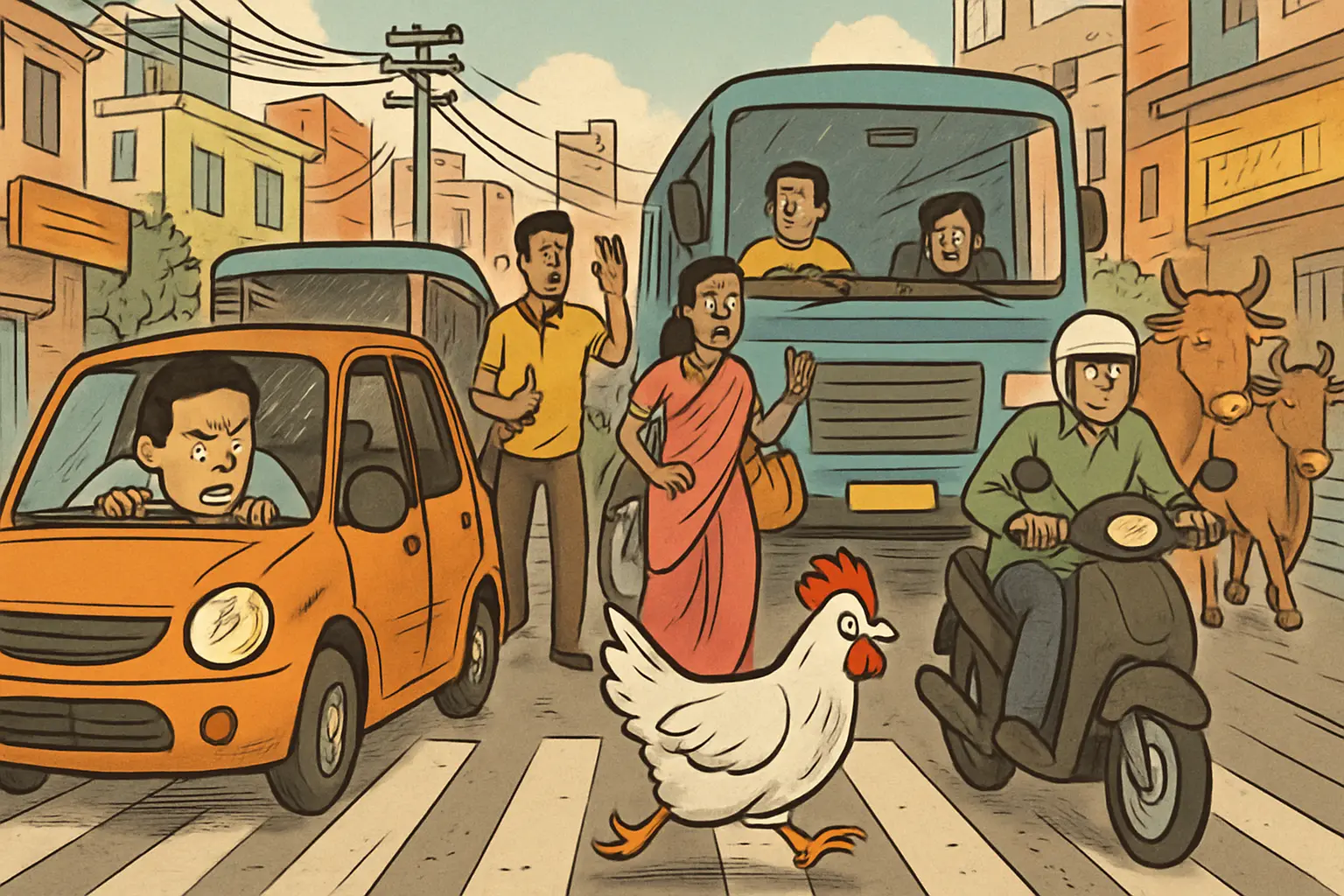
At sunrise, the fishmonger’s whistle on Chicken Road carries through humid air, the chai stall lights blink on, and a bus conductor shouts for the first passengers while sweepers push last night’s dust into neat piles. Before long, the street is a negotiation: rickshaws nudging past parked SUVs, delivery bikes threading impossible gaps, pedestrians testing faith at every zebra crossing faded by monsoon. A woman with a school bag on one shoulder and a five-year-old on the other steps down from a broken curb and wades through traffic that should have been still at a red light. It isn’t. By late afternoon, the sun bakes a set of new asphalt patches laid over yesterday’s utility cuts. By evening, a brief storm turns potholes into wells. The lane where the vegetable vendor set up his cart in the morning becomes a parking bay. The sidewalk becomes a seam of retail. The bus stop becomes a stage room for gig-workers checking three apps at once.
I have walked, surveyed, and filmed streets like this from Thane to Tambaram, from Gurugram’s towers to Kolkata’s bazaars. Locals in one city literally call their chaos strip “Chicken Road.” But the truth is that Chicken Road isn’t an address; it’s a diagnosis. It is what Indian urban streets become when design, governance, and enforcement fail simultaneously. It is a street-level x-ray of how we build and sustain mobility for millions and how, too often, we don’t.
Definition box: Indian urban chaos on the roads
- What it is: Recurrent congestion, high crash risk, obstructed footpaths, illegal parking, waterlogging, trenching, and disorderly curb use on dense city streets.
- What drives it: Unplanned urbanization, fragmented road ownership, car-centric design, weak enforcement, unmanaged street vending and parking, and neglected drainage/utilities.
- Why it matters: Lost time and productivity, injury and death, higher logistics costs, polluted air, unsafe streets for children and elders, and a city that works only for the few.
What “Chicken Road” reveals about Indian streets
Walk ten minutes on Chicken Road and you’ll meet everyone our urban transport system claims to serve, all fighting for space it never gave them.
- The pedestrian: She steps off a footpath narrowed by a freshly built ramp into a car porch. She dodges a two-wheeler climbing the curb to shortcut the signal. She finds no safe, continuous walkway because utility poles have eaten the sidewalk and shop displays have finished the job. This is footpath/sidewalk encroachment India in daily motion.
- The hawker: He can pack, unpack, and relocate within minutes because he knows enforcement patrol cycles and high-footfall time slots. He pays for protection in cash or by staying invisible. He has papers under the Street Vendors Act but little certainty about where he can legally vend. On a good day he feeds a thousand people. On a bad day he’s told to disappear.
- The driver: She is neither villain nor victim alone. Curbside parking is cheaper than a plate of idli; why pay for a garage? The turn pockets are too short; the signals are uncoordinated; right-turn restrictions don’t match desire lines. She parks wherever others have already parked. She knows enforcement is sporadic. The result is illegal parking India, normalized.
- The delivery rider: He is a human metronome of the new economy—pick, deliver, repeat—riding a bike that must be everywhere at once while his app rewards speed over safety. He navigates the last-mile connectivity India never provided, filling a service hole with risk.
- The commuter bus: It crouches on the curb because the designated bay hosts a line of parked vehicles. Its door opens into a drain grate. The bus loses time in mixed traffic. A bus priority lane existed for a month on another corridor and then disappeared under political pressure. Meanwhile, bus stops lack proper shelters, lighting, and level boarding.
- The utility engineer: She has a work order for a fiber-optic trench. The road was resurfaced last week. She knows there is no utility duct. She cuts today because that’s the only way, then promises to restore the carriageway. Her vendor’s contract has a defect liability clause on paper. On ground, monsoon water will tell you how that story ends.
Chicken Road holds up a mirror. It shows how urban disorder in Indian cities is built on tiny rational choices that—taken together—compound into chaos. It also shows that people improvise and survive every day. The cost of that survival is steep and uneven.
The governance maze: who owns the road
Ask a simple question—who is responsible for fixing this street?—and watch the maze unfold. India traffic chaos explained always involves the governance map.
- Urban Local Body (ULB): The municipal corporation or council typically owns and maintains most city roads. Ward engineers handle potholes, footpaths, streetlights, and small junctions. Budget is chronic; O&M is underfunded.
- State Public Works Department (PWD): Arterials, major district roads, and state highways running through the city may be under PWD. Curbs, medians, and carriageway quality depend on PWD norms, not municipal guidelines.
- Development authorities: In some metros, development authorities or special purpose vehicles manage certain corridors, often near new townships or transit lines.
- Traffic police: Signal timing, enforcement of parking and moving violations, and crash investigation. They advise on junction design, but they do not build.
- Utilities: Power, water, sewerage, telecom, gas. Each holds separate permissions for road cutting and often acts without a common trench plan, resulting in repeated cuts.
- Transit agencies: Bus corporations, metro rail companies, and parastatals own stations, depots, and adjacent land. First/last mile is everyone’s and no one’s responsibility.
- State/national road agencies: NHAI and MoRTH for national highways extending into urban limits. Their mandate is mobility and safety at higher speeds—often mismatched with a city’s street life.
The result is a patchwork of standards. IRC street design standards exist; ULBs may adopt some, PWDs others. Smart Cities Mission-style road redesign projects demonstrate “Complete Streets India” concepts on a few corridors; then the old ways return in maintenance cycles. Coordination is episodic, not institutional. If you want to fix Chicken Road, you must align at least five agencies and three budgets.
Data check: crashes, congestion, and costs
Numbers matter because anecdotes alone can be dismissed. The latest Road Accidents in India report by MoRTH carries an aching truth: deaths and serious injuries remain stubbornly high. Pedestrian fatalities India stats show that roughly one in six people killed on our roads is on foot, and two-wheeler riders make up the largest share. Urban crash “black spots” cluster at familiar scenes—wide arterials with chaotic merging, signal-free corridors near flyovers, and junctions lacking refuge islands or raised crossings.
Congestion costs are harder to pin down across cities, but every logistics manager knows the number intuitively—more buffer time, more fuel, more staff, more money. When monsoon potholes India return every season, the costs ripple: vehicle maintenance, injury risk, slower emergency response, and lost trust in public works. Add health costs from air and noise pollution, and the price of chaos is paid daily and silently.
We also know what works. Cities that have implemented bus priority lanes on busy corridors have delivered reliable travel time savings for thousands per hour. Tactical urbanism at crash-prone junctions has cut conflict and reduced speeds. Enforcement cameras with e-challan systems have made a dent in red-light jumping and lane violations where they’re used consistently.
Five root causes of road chaos
- 1) Car-first street design and induced demand
A clear lane and a fast flyover are seductive. But when every problem looks like a moving car, every solution becomes a flyover or a signal-free corridor, and the street below frays. Widening roads and adding grade separation can reduce delays briefly; then induced demand fills the space, and you’re back where you started, with more dangerous crossing conditions for everyone not in a car. India’s unplanned urbanization meets car-first policy and the result is predictable: speed where it should be controlled, danger where life is lived.
- 2) Encroachment on Indian roads and unmanaged curbs
Encroachment is a hot-button word, usually aimed at hawkers. The larger truth is that the curb—the most valuable stretch of public space per square meter—is mismanaged. On-street parking is underpriced or unpriced. Construction debris, permanent ramps, and garden fences intrude into the public right of way. Poles and utilities slice footpaths into fragments. Hawker policy India remains under-implemented; hawkers are moved, not managed. All of this steals the street from its primary users: people walking, cycling, and boarding buses.
- 3) Fragmented accountability and trench warfare
Every time a freshly resurfaced street is cut open for a cable or pipe, it advertises the absence of a coordinated utility corridor. Utility trenching and road cutting permissions occur without a common registry, a hard timeline for restorations, or a fee structure that disincentivizes repeat cuts. Defect Liability Periods exist on paper but enforcement is uneven; restoration is often a quick fill, not a base-to-surface rebuild. Poor compaction and water ingress turn cuts into potholes by the next rain.
- 4) Weak enforcement and perverse incentives
Enforcement has modernized—e-challan data, enforcement cameras—but the perception of random certainty persists. If illegal parking is hardly penalized and legal parking is expensive or unavailable, the market signals are clear. If helmet checks are concentrated on one stretch while wrong-side riding elsewhere draws no action, the message travels fast. Enforcement without street design fixes breeds resentment; design without enforcement fails to sustain outcomes.
- 5) Drainage ignored, monsoon punishment guaranteed
Urban flooding on roads India is not a surprise; it is a schedule. Stormwater drains silt up; desilting is rushed; silt disposal is often poor; inlet grates are mismatched to debris patterns. The moment it pours, water has nowhere to go. Asphalt ravels, potholes multiply, and “potholes in India monsoon” becomes both headline and meme. Heat later compounds the damage; bitumen softens; rutting worsens.
Street-level problems through the lens of Chicken Road
- Illegal parking India: Cars straddle both sides of a two-lane road, effectively turning it into one. The signal cycles do nothing because the bottleneck is after the intersection. A simple on-street parking pricing and time-limit policy can free up the curb for drop-offs, buses, and deliveries, but few cities attempt it beyond a pilot.
- Footpath/sidewalk encroachment India: Actual pedestrian space shrinks below a meter, violating minimum standards. Wheelchairs and prams confront a slalom course. Enforcement pushes vendors onto the carriageway, raising risk for everyone.
- Potholes and trench restoration: Utility cuts lack proper base layers. Temporary cold mix is permanent. Contractors chase quantity, not quality, and ULBs struggle with oversight capacity. Grievance portals explode during the rainy season; response times lag just when they matter most.
- Urban flooding and stormwater drains: Inlet spacing is inconsistent; grates are clogged; shoulder gutter lines are broken; outfalls are blocked by silt, vegetation, or construction waste. A day of rain erases a month of promises.
- Last-mile connectivity India metro: The metro is excellent but the last kilometer is a weak link. E-rickshaw last mile India fills the gap, but without curb management and bay design, stations become choke points.
- Gig mobility and delivery bikes: High pressure on delivery riders produces risky maneuvers. They form their own curbside behavior patterns, which police neither accommodate nor manage. Designated pickup zones and short-stay bays are rare.
- Utility coordination: Each agency carries its own map; none carry one map together. Even when a smart city project builds a duct, tapping into it for future work is not standard practice across utilities.
Who is responsible for maintaining city roads in India?
Responsibility, in practice, looks like this:
- Carriageway (most local streets): ULB roads department or ward engineer.
- Arterials cutting across multiple wards: ULB central engineering or PWD.
- Traffic signals and junction operation: Traffic police (sometimes with ULB electrical department).
- Footpaths and pedestrian crossings: ULB or the agency that built the last redesign.
- Bus stops and shelters: Transit agency or ULB through a concessionaire.
- Stormwater drains: ULB stormwater cell; outfalls may be with irrigation or environment departments.
- Utility trenches: Utility agency obtains permissions; road-owning agency signs off. Restoration duty is on the cutter, oversight on the owner.
The maze would be less punishing if cities had a single “street owner” per corridor with convening power and a budget to match. Instead, jurisdiction changes every few hundred meters and with every function.
The anatomy of failure and the anatomy of a fix
Consider this compact view of Chicken Road’s everyday symptoms, their roots, who owns them, and what fixes work.
| Symptom | Likely root cause | Primary owner | Proven fix |
|---|---|---|---|
| Obstructed footpaths | Unmanaged curb/encroachment, poor design | ULB | Continuous footpaths with clear widths; raised crossings; hawker zones with delineation; periodic enforcement |
| Congested junctions | Overly permissive turning, short turn pockets, long cycle lengths | Traffic police + ULB | Junction redesign, shorter cycles, dedicated turn pockets, refuge islands, turn restrictions, adaptive signals |
| Repeated trenches | No utility duct, weak restoration SOP | Road owner + utilities | Common trench/duct policy; restoration standards; trench fees tied to restoration quality; moratorium windows |
| Chronic illegal parking | Underpriced curb, no allocation for deliveries | ULB + traffic police | On-street parking pricing, loading bays, resident permits, strict tow policy, digital payments |
| Monsoon potholes | Poor base preparation, clogged drains | ULB | Pre-monsoon drain audit; full-depth patching; hot-mix spec compliance; contractor accountability |
| Crash hotspots | High speeds, uncontrolled crossings | Road owner + traffic police | Traffic calming; raised pedestrian crossings; lane narrowing; speed cameras; Vision Zero-style targets |
Why are Indian roads so chaotic?
Because the system optimizes for the loudest vehicle and the quickest fix. Because we built a street hierarchy without a people hierarchy. Because responsibility is shared in theory and scattered in practice. Because we tolerate rule-bending when rules don’t reflect reality. Because funding flows smoother for big-ticket projects than for maintenance and design.
Encroachment is not a morality tale. It is a management problem. Hawkers cluster where footfall is high and where they are tolerated. Cars cluster where parking is unpriced. Delivery vans idle where loading bays do not exist. If you do not plan the curb, the curb will plan you.
Case studies: what has worked in Indian cities
Chennai’s T Nagar pedestrian plaza
A bustling commercial spine was redesigned to make walking the default mode. Continuous footpaths, granite pavers, and traffic calming created a space where shoppers could stroll without fear. Vendors were integrated with designated pitches. After completion, footfall increased, shopkeepers reported better sales, and crash risk fell. The plaza became a civic space with events and performances, a rare street where the city felt like a city, not a corridor for vehicles. The lesson for Chicken Road: prioritize people, and commerce follows.
Pune’s Complete Streets program
The city adopted a Complete Streets design manual and built pilot corridors with wide, shaded footpaths, cycle tracks, and safer junctions. The program moved beyond a one-off beautification; it produced templates that contractors could follow and ward engineers could maintain. Outcomes included improved walkability, safer school routes, and a shift in civic expectations: citizens began asking for “a Pune Complete Street” by name. The lesson for Chicken Road: standards plus champions produce continuity.
Ahmedabad’s BRTS/Janmarg
A citywide bus rapid transit system created median busways with level boarding, priority signals, and good frequency. Even with design compromises at some junctions, ridership climbed into six figures. When buses move fast and reliably, two-wheelers and cars lose their aura of inevitability for longer trips. The lesson for Chicken Road: reclaiming the median can move more people, not fewer.
Indore’s street vending policy
Rather than treat hawkers as an enforcement problem, the city advanced Town Vending Committees, created vending zones, issued ID cards, and aligned vending with pedestrian priority. Compliance improved because legitimacy bred order. The lesson for Chicken Road: manage, don’t ban.
Kolkata’s hawker regulation
Kolkata mapped hawker-dense streets and negotiated hours, pitches, and access widths. The approach acknowledged culture and commerce while safeguarding emergency access and essential footpath clearance. The lesson for Chicken Road: context matters; a hawker is part of the street’s economy.
Bengaluru’s bus priority and camera enforcement
A stretch of bus lane showed immediate time savings for bus riders; cameras and social media helped maintain discipline. Though scaling ebbed and flowed, the experiment proved a point: space, once reallocated with conviction, can hold. The lesson for Chicken Road: pilot, measure, and communicate relentlessly.
Mumbai’s maintenance reform
Some wards moved to asset tagging of potholes, e-tendering transparency, and contractor blacklisting for poor performance. Citizen reporting apps began closing the loop between complaints and ground action. The lesson for Chicken Road: accountability can be built into contracts and dashboards.
Hyderabad’s utility coordination
Joint trenching protocols in some corridors reduced repeated cuts. Agencies aligned their work windows, and restoration standards improved. The lesson for Chicken Road: if you schedule pain once and restore well, people forgive you faster.
Quick wins and long-term reforms
Quick wins for Chicken Road
- Paint-and-post tactical urbanism: Use cones, planters, and paint to tighten junction corners, create pedestrian refuge islands, and slow turning speeds. Document before-after speeds and near-misses.
- Raised pedestrian crossings at schools, hospitals, and markets: Force slower entry speeds. Build them to spec; not speed-breakers masquerading as tables.
- On-street parking pricing on commercial stretches: Start simple—digital payments, clear signage, higher fees during peak hours, and free first fifteen minutes for quick errands. Pair pricing with strict towing against double-parking.
- Delivery and ride-hail bays: Mark and enforce short-stay bays near major shops and office entrances. Give enforcement teeth: camera evidence, e-challan.
- Hawker zones with painted pitches: Work with Town Vending Committees to allocate space and keep clear walkways. Provide waste bins and water points; dignity supports compliance.
- Signal timing audits: Shorten cycles at low-volume hours; add pedestrian-only phases at high-conflict junctions. Use low-cost countdown timers and audible signals where possible.
- Pre-monsoon drain action: Clean inlets, fix shoulder drains, clear outfalls, and schedule your stormwater sweep weekly through the season. Publish ward-wise progress.
Long-term reforms for Indian urban roads
- Street ownership model: Assign a single lead agency per corridor with budgetary command and accountability for multimodal outcomes. Use corridor performance metrics: crashes, left-to-right crossing time, bus travel speeds, and encroachment-free footpath continuity.
- Parking policy overhaul: Formalize on-street parking with pricing that responds to demand. Ring-fence revenue to maintain the same street. Build structured parking only where pricing signals and land-use justify it.
- Utility ducting: Install common utility ducts under major corridors. Put in place a trench moratorium after resurfacing and steep fees for out-of-window cuts. Restore base-to-surface, not surface-only.
- IRC-aligned design codes: Adopt urban street design standards that presume people first, speeds controlled, and crossings safe. Train contractors and ward engineers; don’t outsource understanding.
- Vision Zero-style targets: Commit publicly to reducing fatalities and serious injuries, with a dedicated budget for black spot remediation. Use enforcement cameras transparently, publish e-challan data, and measure reoffending.
- Transit Oriented Development India: Update development control rules to promote density near transit with reduced parking minimums, strong NMT infrastructure, and mixed-use zoning. If you build proximity, you cut trips.
- Bus priority at scale: Reserve median or curbside lanes on key corridors, upgrade depots and fleet, and pair lanes with signal priority. Better buses are a universal equalizer.
- Stormwater and climate resilience: Redesign drains for intense bursts, standardize gully spacing, use permeable shoulders where possible, and keep catchment maps public. Heat-proof pavements where rutting is chronic.
- Budget and O&M reform: Shift capex obsession to lifecycle thinking. Maintain what you have with grace. Performance-based maintenance contracts can be a tool; so can community oversight.
Flyovers vs Complete Streets: a comparison that matters
| Choice | Short-term travel time | Long-term congestion | Safety for pedestrians | Cost and maintenance | Who benefits most |
|---|---|---|---|---|---|
| Flyovers/signal-free corridors | Often reduced for car through-traffic | Often returns due to induced demand, worsens on ramps | Worse at at-grade junctions and slip roads | High upfront, high upkeep | Through-car users, inter-neighborhood trips |
| Complete Streets with traffic calming | Slightly moderated for cars, improved for buses | Stabilizes with mode shift and predictable speeds | Significantly better with raised crossings and refuge | Moderate upfront, manageable upkeep | Walkers, cyclists, bus users, local commerce |
The myth that a city can build its way out of congestion with flyovers keeps Chicken Road in permanent adolescence. The path to adulthood is a mature street hierarchy that asks stubbornly: how many people can we move and protect, per meter, per minute?
How to navigate responsibility and get things done as a citizen
When you live on Chicken Road, you learn to become part reporter, part planner, part negotiator. Here’s how to make the system work a little better.
- Know the owner: Find the ward number and the road-owning agency. ULB portals list ward engineers and road departments. A call and a polite email begin the paper trail.
- Use citizen reporting apps: Most cities run grievance redressal portals. Log potholes, blocked drains, or broken signals with a photo, pin-drop, and a specific location description. Follow up weekly; escalate to the zonal office if deadlines slip.
- Report black spots: If a location sees repeated crashes or near-misses, document it. Traffic police have black spot remediation programs; use their online forms where available.
- Engage the ward committee: Many corporations have ward committees and Area Sabhas. Request a street walk with the engineer and traffic inspector. Bring data—counts of parked cars, bus delays, school crossing times.
- File RTIs or public queries for utilities: When trenching happens, ask which utility is cutting, the permission number, and the restoration timeline. Public questions catalyze compliance.
- Partner with RWAs and shop associations: Joint petitions are harder to ignore. Shop owners respond to parking pricing when curb chaos hurts their own customers.
- Don’t ask for sweeping crackdowns against hawkers: Ask for vending zones with clear walkways and waste management. Enforcement without accommodation is unsustainable and often unjust.
- Demand before/after: For any redesign, ask for the basic baseline stats—walking times, bus travel times, crashes. Measure again after. Publish the results on social media and tag agencies.
Policy and responsibility made simple
- MoRTH road safety report insights remind us that vulnerable road users matter most. Cities must audit their top crash corridors annually and fix design issues, not just deploy policemen.
- Hawker policy India explained: The Street Vendors Act protects livelihoods and mandates Town Vending Committees that demarcate vending zones. Implementation is the gap. When zones are defined and serviced, conflict reduces.
- Parking policy India on-street: Best practice is to price and manage on-street parking as a public good, not an entitlement. Free curb space is a subsidy without a name.
- IRC street design standards India: These provide for narrower lanes in urban contexts, design speeds preset, raised intersections near schools, and continuous footpaths that respect desire lines and property access.
- Smart Cities Mission road redesign: Many cities built demonstration corridors with granite footpaths and improved lighting. What matters is maintenance and scale, not just ribbon-cutting.
- Viksit Bharat urban plan roads: The national aspiration for developed cities requires not just expressways but high-quality local streets. Metrics must move from kilometers built to casualties avoided and people moved.
Design tools for safer Chicken Roads
- Complete Streets India: Streets for everyone, not just cars. That means continuous footpaths with clear widths, cycle tracks where demand exists, and safe transit boarding.
- Road diet and traffic calming India: Reduce excessive lane widths and number of lanes to match demand; use chicanes, tightened corners, and raised crosswalks to lower speeds.
- Tactical urbanism India: Short-term, low-cost changes to test new layouts rapidly; deploy cones, paint, and planter boxes to measure effects before investing fully.
- Bus priority lane India: When buses move faster than cars, demand shifts. Protected lanes, stop-level boarding, and signal priority make it stick.
- Cycle lanes India challenges: Space, continuity, and protection from parking intrusions are the triad. Painted lanes alone invite misuse; bollards and curbs protect.
- Safe pedestrian crossings India: Zebra stripes are not magic. Markings need raised tables near schools and markets, pedestrian refuge islands, and shorter crossing distances.
- Black spot remediation India: Analyze crash patterns, redesign geometry, and monitor outcomes. Speed control is your first therapy.
The seasonal rhythm: monsoon, heat, and the festive surge
Monsoon potholes India are a ritual that must end. Pre-monsoon drain cleaning, crack sealing, and roadway sweeping reduce damage. Gully pit covers must be matched to debris types; otherwise, they clog in a day. The moment it rains, visible puddling points to either depression (structural failure) or blocked drainage inlets. Repair strategy matters: cold-mix patches offer a stopgap, but full-depth repairs are the cure.
Heat stresses our roads too. Softening bitumen makes rutting and scuffing worse at junctions where braking and acceleration rip the surface. Higher-albedo materials and better binders help; so does shade, which also benefits those who walk.
The festive season and school reopenings bring predictable traffic surges. A city with a plan adjusts signals, reassigns traffic police posts, and enforces on-street parking rules with a smile and a tow truck. A city without a plan watches Chicken Road mutate into a parking lot.
The political economy of the curb
A curb meter that charges a fair rate for on-street parking can fund the very sidewalk it borders. Yet few cities do it because free curb space feels like good politics. Meanwhile, the cost of free parking is paid by everyone in lost time and safety. Encroachment on Indian roads thrives in unmanaged spaces; once you price, mark, and enforce, behavior shifts. Markets respond to incentives; so should city halls.
Hawkers deserve predictability. When vending zones are close to demand, well-serviced, and fairly priced, hawkers will stay within lines because their customers will find them. When zones are in the middle of nowhere, the system invites evasion. फुटपाथ अतिक्रमण इंडिया as a hashtag is a symptom; a hawker is a businessperson with bills. Design for that reality.
Gig mobility and e-rickshaw last mile India need curbspace and rules that respect speed differentials and safety. Short-stay bays near malls and office towers, and signed staging zones for e-rickshaws at metro stations, turn chaos into choreography.
A street-level blueprint for Chicken Road
If I were handed the keys to Chicken Road with one chief engineer, one beat traffic inspector, and one ward budget officer at the table, here’s the sequence I’d push.
- Map and measure: Week one, count everything—walkers at peak, cyclists, bus dwell times, turning volumes, illegal parking occupancy, near-misses. Map stormwater inlets and drain lines. Photograph every trench. Publish a one-page baseline.
- Communicate the change: Put up corridor boards with a timeline and contact numbers. Tell citizens what’s coming and why—safer crossings, faster buses, clearer footpaths.
- Fix drainage first: Clear inlets, repair broken shoulder drains, and ensure outfalls are open. Water is enemy and amplifier.
- Protect people at junctions: Deploy tactical kerb extensions with paint and bollards. Add raised crossings by schools and markets. Adjust signals for shorter crossing wait times.
- Allocate the curb: Stripe on-street parking bays with pricing and time limits for short-stay retail. Mark delivery bays and ride-hail pick-up zones. Designate hawker pitches with paint and bins.
- Bus priority where feasible: If the corridor is a bus spine, carve out a bus lane or queue jump at signals. Enforce it with cameras.
- Repair truly, not cosmetically: Where roads fail structurally, do full-depth repairs. Ban surface-only patches over trenches.
- Enforce with fairness: Start with warnings and placards. Move to e-challans and towing. Keep fines proportionate and consistent. Publish weekly enforcement stats.
- Keep the loop alive: Update citizens—before/after travel times, crash trends, footpath continuity achieved. Celebrate wins. Own failures quickly and fix.
India’s street laws and how to use them
- Motor Vehicles Act empowers traffic enforcement but also mandates design obligations for safety. Use that to demand geometry fixes, not just fines.
- MoRTH standards and IRC guides exist to make safer urban streets. Point to them when you see overwide lanes, missing tactile paving, or excessive corner radii.
- The Street Vendors Act establishes a legal framework: vending certificates, designated zones, and eviction procedures subject to committee oversight. If your chicken roll vendor has papers, he has standing.
- ULB by-laws often include parking regulations and building-line rules. When a property extends its ramp into the public right of way, by-laws give the city teeth to act.
Equity on Chicken Road
Every street is a justice issue. भारतीय सड़कों की अव्यवस्था weighs heaviest on those who walk, cycle, or ride buses—often the lowest emitters and the least protected. A child crossing to school, a nurse heading to a night shift, an elderly couple going to the clinic—these are the people for whom urban design must work first. सड़क सुरक्षा आँकड़े भारत tell a story of preventable tragedies. Vision Zero is not a European luxury; it is a moral compass for Indian cities.
Comparative think-piece: car-centric planning vs multimodal India
We tend to split into camps: flyovers for speed vs plazas for people. Both instincts respond to pain; both are incomplete when held alone. Signal-free corridors can be useful for bypass traffic; they are disastrous when used within city grids to move cars a few minutes faster at the cost of safe crossing for thousands. Multimodal design—walk, cycle, bus, para-transit, cars—recognizes the Indian street as a habitat. The question is not whether cars belong; it is how much space they should reasonably occupy, where, and at what speed.
India traffic chaos explained better begins with a cultural reset. The horn, the lane-straddle, the wrong-side slither—these are not genes; they are behaviors shaped by the street. Change the geometry and the incentives, and the behavior follows.
FAQ: fast answers for frustrated citizens
Why are Indian roads so chaotic and how can they be fixed?
Chaos stems from car-first design, underpriced curb space, weak enforcement, uncoordinated utilities, and neglected drainage. Fixes include Complete Streets, parking pricing, bus priority, utility ducts, black spot remediation, and Vision Zero-style targets. Manage hawkers and deliveries; don’t criminalize them.
Who is responsible for maintaining city roads in India?
Local streets: municipal corporations. Arterials: PWD or ULB. Signals and enforcement: traffic police. Drains: ULB stormwater cell. Utilities: their own agencies, with permissions from the road owner. The challenge is coordination; demand a single corridor owner.
How do street vendors impact traffic and walkability in India?
Vendors bring life and convenience. Without designated space, they can block footpaths and spill into carriageways. With vending zones, waste bins, and clear access widths, they coexist with safe walking and smooth traffic.
What causes potholes every monsoon in Indian cities?
Poor trench restoration, inadequate base layers, clogged drains, and water ingress. Quick fixes fail; full-depth repairs, strict restoration standards, and pre-monsoon drain maintenance prevent recurrence.
How effective are bus priority lanes in India?
Where properly enforced, bus lanes cut travel times and improve reliability, attracting riders from two-wheelers and cars. The key is continuity, signal priority, and political support.
What is the cost of congestion in Indian cities?
Costs add up as lost time, fuel, vehicle maintenance, higher logistics expenses, and health impacts from pollution. While city-wide numbers vary, businesses and commuters feel the pinch daily.
How safe are pedestrians on Indian roads?
Data shows pedestrians account for a significant share of fatalities. Safety improves with raised crossings, slower speeds, continuous footpaths, and strict enforcement. Design changes are non-negotiable.
Why do Indian roads get dug up repeatedly?
Fragmented utility planning, absence of common ducts, weak restoration standards, and misaligned work windows. A common trench policy and trench fee structure tied to restoration quality are the cures.
Hindi quick definitions for reach
- भारत में ट्रैफिक जाम के कारण: गलत सड़क डिजाइन, अतिक्रमण, कमजोर प्रवर्तन, और खराब जल-निकासी।
- मॉनसून में गड्ढों वाली सड़क: खराब ट्रेंच रिस्टोरेशन और पानी भराव की देन।
A final walk down Chicken Road
By night, Chicken Road quiets. A stray dog sleeps on a warm patch of asphalt. The last metro feeder drops a handful of passengers who walk home under dim lights. The fresh paint of a new crossing glows. It will survive if the turning radius nearby is tightened and speeds come down; it will fade into memory if it remains decoration without geometry.
Chicken Road is a parable, not a punchline. It tells us that Indian urban chaos on the roads is not destiny. It is a set of design choices, policy defaults, and enforcement patterns that can be reversed. The city that chooses to manage its curb, that takes a lane from cars to give to buses, that treats hawkers as partners, that stops worshiping at the altar of the flyover, that city writes a different story.
The most hopeful thing I’ve learned, walking and filming these streets for years, is that streets respond immediately to respect. Lower a corner radius, and turning speeds drop tonight. Install a raised crossing, and children look less frightened tomorrow. Price parking, and buses stop getting blocked next week. Mark hawker pitches and pick-up bays, and chaos turns to choreography. Fix one street as if it were yours, and the city remembers how to fix the next.
Chicken Road will always be there, in some city, calling us out. The answer is to build so many safe, human streets that the nickname sounds absurd. When that happens, the fishmonger’s whistle at sunrise will still be there. The difference is that everyone will have room to walk past him without fear.
