
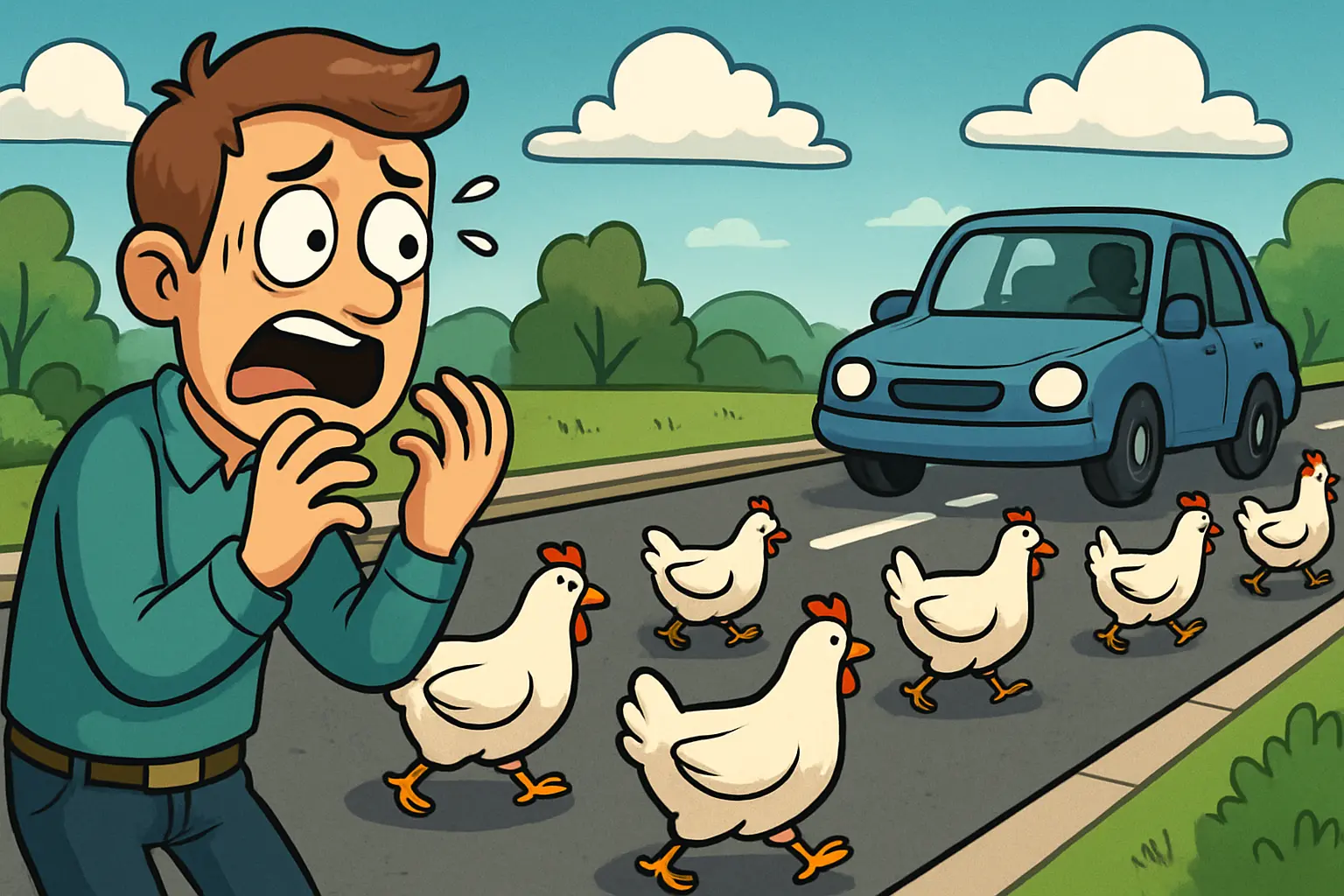
Open a mobile endless runner and it gives you a fantasy: sprinting between lanes, zigzagging past trucks, leaping from log to log. A half-second late? You respawn. Asphalt is forgiving when it’s made of pixels. The real thing isn’t. If Chicken Road were real—if Crossy Road or Frogger crawled out of the arcade and onto a multilane highway—your survival window would be measured in seconds, not minutes. And the reason has nothing to do with courage. It’s a brutal mix of reaction time, vehicle speed, stopping distances, visibility, and the way human brains decide when to go.
I’ve spent a lot of time where transportation research meets human behavior: measuring gaps, timing crossings, standing on medians with a notebook as drivers do exactly what their training—and their adrenaline—says they should. I’ve watched expert sprinters misjudge a lane, cyclists mistime a gap, drivers misinterpret a step off the curb. It looks like a game. It isn’t.
Here’s how long you’d last on Chicken Road, and why the math of human vs traffic survival odds turns the fantasy of a real life endless runner into a razor-thin negotiation with physics.
What Chicken Road Looks Like in Real Life
In games, you get discrete obstacles: a lane, a log, a train. In the real world, an endless runner doesn’t come packaged with uniform gaps and neat spawns. It’s a spectrum of roads and risks:
- Two-lane urban streets at 20–30 mph, with legal crossings and signals.
- Four-lane arterials at 35–45 mph, inconsistent gaps, multiple-threat scenarios where one car stops and the next keeps moving.
- Six-lane divided highways at 50 mph and up, high traffic volume, longer vehicle platoons.
- Freeways with ramp merges, sightline limits, and posted speeds humans were never meant to share on foot.
“Chicken Road” in real life would almost certainly be a multilane arterial or freeway—fast speeds, heavy volumes, no protected crossings—because that’s the only setting that feels like an endless runner. And it’s the exact setting where a human body is at its weakest.
Crossy Road in real life? You won’t get coin drops or lucky spawns; you get physics and probabilities. Would you survive Crossy Road IRL? Only if you turn it back into a regular street crossing with protection, signal timing, and blessings from the traffic gods.
The Physics That Decide Your Fate
If you want to survive a real life road crossing challenge, the deciding variables are heartbreakingly simple.
- Your reaction time: Typical human reaction to an expected stimulus hovers around 0.2–0.3 s. To an unexpected vehicle movement, a more realistic real-world average falls between 1.0–1.5 s. That’s the pause before you even move.
- Your acceleration and sprint speed: A reasonably fit adult can hit 6–8 m/s in a short sprint. Elite sprinters, faster. But acceleration to that speed takes distance. Most people top out nearer 4–6 m/s during short bursts across lanes.
- Lane width and crossing distance: A single lane is roughly 3.0–3.6 m. Two lanes with a median turn lane can be 10 m or more. Four lanes, add a refuge island if you’re lucky.
- Vehicle speed: A passenger car at 20 mph travels about 9 m/s; at 30 mph, about 13 m/s; at 40 mph, about 18 m/s; at 60 mph, about 27 m/s.
- Stopping distance: Drivers need time to perceive, react, and brake. Even a modern car takes a football-field’s worth of space to stop from freeway speeds. On wet pavement, add more.
- Visibility: At night, a pedestrian in dark clothing isn’t effectively visible until a car is almost on top of them; retroreflective materials and lights extend detection range dramatically.
Video game physics vs real life? Games give you a small hitbox, top-down vision, predictable patterns, and frictionless direction changes. Real life gives drivers finite sightlines and humans who need traction, time, and oxygen.
Pedestrian Survival Rates by Impact Speed
If a car hits you, the impact speed dominates the outcome. The relationship isn’t linear; it’s a curve that ramps hard. Different studies produce slightly different numbers, but the pattern is consistent across sources like NHTSA, IIHS, and global safety agencies: as impact speed rises, the chance of fatal or catastrophic injury skyrockets.
Summary ranges that align with widely cited research:
- Around 20 mph: Many pedestrians survive, but serious injury is common.
- Around 30 mph: Severe injury risk spikes; fatalities become increasingly likely.
- Around 40 mph and up: Fatality risk is high; survivability plummets.
Table: Approximate risk trend by impact speed (pedestrian vs passenger car)
| Speed (mph) | Likely outcome range (approximate) |
|---|---|
| 20 | Low-to-moderate fatality risk; high injury risk |
| 25 | Moderate fatality risk; severe injury common |
| 30 | Substantial fatality risk; very high severe injury risk |
| 35 | High fatality risk |
| 40 | Very high fatality risk |
| 50+ | Extremely high fatality risk |
These are not guarantees. A child struck at 25 mph can die; an adult struck at 35 mph can survive. Vehicle type, angle of impact, height, and what you land on matter. But the curve doesn’t soften just because you’re careful. In endless runner terms: each extra 5–10 mph is like adding a boss level every lane.
Stopping Distance at Traffic Speeds
A driver seeing you at the last second is not a rescue plan. They need distance, and there often isn’t enough.
Key components:
- Perception-reaction time: 1.0–1.5 s in real-world surprise situations.
- Braking deceleration: Varies by vehicle, speed, and surface. A passenger car on dry pavement might pull roughly 0.7–0.8 g under hard braking; on wet pavement, less.
Table: Typical stopping distances for a passenger car
| Speed (mph) | Reaction distance (1.2 s) | Braking distance (dry) | Total stop (dry) | Total stop (wet) |
|---|---|---|---|---|
| 20 | ~11 m | ~8–10 m | ~19–21 m | ~22–26 m |
| 30 | ~16 m | ~18–22 m | ~34–38 m | ~40–48 m |
| 40 | ~22 m | ~32–40 m | ~54–62 m | ~65–78 m |
| 60 | ~33 m | ~70–90 m | ~103–123 m | ~125–160 m |
These are representative ranges; SUVs, trucks, and buses increase the distances. Night visibility further reduces the effective detection distance; wet roads add tens of meters; downhill grades add more.
If you’re halfway through a lane when a driver first notices you at 40 mph, there’s a good chance there isn’t enough room to brake to zero before impact—even if they react immediately and brake hard.
How People Actually Decide to Cross: The Gap Acceptance Problem
Traffic engineers talk about “gap acceptance”—the shortest time gap in traffic that a person judges safe enough to step off the curb. It’s a chess problem, solved in a blink, with your life as the king.
Consider a single lane with vehicles arriving at random. The times between vehicles are gaps. If those gap lengths behave like a Poisson process (a decent approximation on an unsignalized road), then the probability of a gap longer than t seconds is roughly e^(−λt), where λ is the average arrival rate of vehicles per second. Heavy volumes mean large gaps are rare. Light volumes mean patience produces longer gaps.
But Chicken Road isn’t one lane—it’s several. And multi-lane roads produce multi-threat scenarios:
- The lead car in lane 1 stops to let you cross, masking you from the driver in lane 2, who still has a green and cannot see you until the last moment.
- The left lane’s vehicles are longer; the right lane’s vehicles are faster. You misread which one controls the conflict point.
- One vehicle accelerates into a newly opened space just as you step into it.
In research, people accept shorter gaps on multi-lane roads than models suggest they should, often because they intend to pause in an “island” between lanes. But many arterials don’t have safe refuge. And even with an island, judging two streams independently is cognitively taxing.
So how many lanes could a human cross before getting hit? That’s not a moral question; it’s a math question, and the answer depends on traffic speed, volume, visibility, and whether there’s somewhere to stop halfway.
Would You Survive Crossy Road IRL? A Simple Survival Model
We can build a back-of-the-envelope model that captures why a real life endless runner is so unforgiving. It won’t be perfect—real roads are messy—but it will be honest.
Part A: Crossing time per lane
- Assume lane width w ≈ 3.5 m.
- Your average crossing speed v_ped during a sprint = 4–6 m/s for most adults.
- Time to cross a single lane t_lane ≈ w / v_ped ≈ 0.6–0.9 s.
This is the best-case slice of your crossing time, not counting starting and stopping. Real humans lose time accelerating, decelerating, and reorienting.
Part B: Safe gap requirement
For one lane with vehicles at speed v_car and a safety buffer B (the distance you want between you and the next car when you exit the lane), the time gap you need is approximately:
t_gap_required ≈ t_reaction + t_lane + B / v_car
Where t_reaction is the time from sighting the gap to stepping off the curb (often ~0.5–1.0 s in real life), and B might be 5–10 m.
For v_car = 13.4 m/s (30 mph), t_lane = 0.7 s, t_reaction = 0.6 s, B = 7 m:
t_gap_required ≈ 0.6 + 0.7 + 7/13.4 ≈ 0.6 + 0.7 + 0.52 ≈ 1.82 s
That’s the theoretical minimum to clear a single lane. Add uncertainty, missed steps, and driver variability, and you quickly want 2.5–3.0 s. On a four-lane road without refuge, multiply the risk of failing any one of those four micro-crossings.
Part C: Probability of finding gaps
Let lanes behave like independent streams with average headway H (seconds between vehicles). Real traffic isn’t perfectly Poisson, but for a worst-case endless runner effect, high and steady flows are more dangerous than random drips.
Probability of finding a gap ≥ t in a Poisson stream is P = e^(−t/H). On a moderately busy arterial, H might hover around 2–3 s per lane in the peak direction. Large gaps exist, but rarely and not in sync across lanes.
If you need 2.5 s per lane and headways average 2 s, the probability that any given slot is usable is e^(−2.5/2) ≈ e^(−1.25) ≈ 0.286. For two lanes simultaneously aligned, it’s roughly 0.286^2 ≈ 0.082. For four lanes, 0.286^4 ≈ 0.0067. That’s once in about 150 headways. With vehicles arriving every 2 s, that’s about a five-minute wait for a perfect four-lane simultaneous gap—if the streams were independent, which they aren’t, and if you could see both directions down the road, which you often can’t.
Part D: Lane-by-lane strategy with a median
Most real-life Crossy Road attempts aren’t single-zip four-lane sprints. People try lane-by-lane, waiting in a narrow refuge between traffic flows. Now your survival is dominated by misjudgment risk. Each new lane is another roll of the dice: are you right about the closest car’s speed? Did you account for a lane change? Did a driver you can’t see floor it?
You can think of your run as a sequence of trials. If the risk of being struck per crossing attempt is p, your chance of surviving N attempts is roughly (1 − p)^N. The expected number of attempts before a hit is 1/p.
If p were as low as 1 in 200 per crossing (an optimist’s view on a road without protection), the expected number of crossings before disaster is 200. At two lanes per crossing of a divided road, that’s 100 crossings—minutes of play in a game, a catastrophic number in the real world. But 1 in 200 is fantasy when speeds are 40 mph and multi-threat masking is present. Field observations on high-speed arterials suggest that if people try to cross at mid-block during heavy flow, the effective per-attempt incident risk is closer to 1 in tens, not hundreds, even without a police report for every near miss.
Part E: The survival clock
An endless runner isn’t just a crossing; it’s repeated exposures. If your per-lane misjudgment risk is small but nonzero—say 1 in 100 for a skilled, alert adult in daylight on a 35 mph four-lane—then a session of 50 or 100 lane decisions pushes your cumulative risk into uncomfortable territory. Now put it at night on a 45 mph arterial and your per-lane risk may climb to 1 in 20 or worse. Your expected survival time drops to a handful of dashes.
What Happens in Specific Scenarios
1) Two-lane city street at 25–30 mph, daylight, marked crosswalk with signals
This is not Chicken Road; it’s normal life. With legal protection, signal timing, and driver expectations aligned with your presence, your survival odds are excellent. If you comply with the signal and cross on “Walk,” drivers are primed to stop. Do crashes still happen? Yes, due to turning conflicts and red-light runners. But this isn’t a real life endless runner. It’s a street.
2) Mid-block four-lane arterial at 35–45 mph, daylight, no refuge island
This is where the fantasy begins and where people get hurt. The gap acceptance problem dominates. Without a median refuge, you need coordinated gaps across multiple lanes and directions. Headways rarely line up. The temptation is to “go now and figure it out in the middle,” which works, until a lane change closes your escape. Many drivers will not expect to stop mid-block for a pedestrian. Your survival odds over repeated attempts evaporate quickly. Expect a handful of crossings at best before a misread or a multi-threat situation ends the game.
3) Six-lane divided arterial at 45–50 mph, daylight, narrow median
Slightly better on paper because you can break the crossing into two halves. In practice, the risks remain punishing. Drivers in the near lane are masked by vehicles in the far lane; acceleration bursts to fill gaps are common. The median may not be wide enough to safely stand. Survival improves versus the four-lane no-refuge case, but only if you maintain military-level discipline: wait for a clean gap in each half and assume the worst from the next lane. Most people don’t.
4) Freeway or motorway at 60–70 mph, any light condition
This is no longer a crossing problem; it’s a mortality problem. Stopping distances are huge. Drivers do not expect you. Curvature, barriers, and merges crush sightlines. Even if you wait for a large gap, platoons of vehicles reduce the number of usable gaps to an agonizingly rare few. Your per-lane misjudgment margin is basically zero; the cost of a wrong step is catastrophic. How long could you survive if Chicken Road were real on a freeway? As long as it takes for the next approach, which can be seconds. Freeways are explicitly engineered to exclude pedestrians because the outcome without that rule is predictable and grim.
5) Rural two-lane at 55 mph, very low volume, daylight, long sightlines
Here, patience can create safety—eventually. Traffic may arrive in bunches with vast emptiness between. If you have the discipline to wait for a truly enormous gap (hundreds of meters each direction), you can cross once and live. Turn it into a game, crossing repeatedly for “fun,” and the small-but-nonzero risk compounds.
Real Life vs Frogger Physics: Why Games Mislead You
- Field of view: Top-down camera in games shows every vehicle’s trajectory. In real life, you see through a windshield’s moving mosaic. You’re blocked by parked cars, pillars, buses, and your own neck.
- Predictable speeds: Games spawn vehicles at uniform speeds. Real drivers fluctuate within lanes, accelerate into gaps, and act on dozens of micro-influences you can’t see.
- Hitboxes: Games often let you “clip” past a bumper; in reality, a side mirror at 30 mph can knock you into the next lane.
- Frictionless direction change: In games, you pivot from forward to lateral instantly. Your hips, ankles, and shoes don’t. Your foot may slip; your bag may catch; your stride may falter.
- Penalties: Games give you a do-over. The street doesn’t.
How Fast Could Traffic Go and You Still Survive a Hit?
This is the wrong experiment, but everyone wonders. Consider just the physics: A human body’s tolerance to impact is finite. The risk of fatality or severe brain injury ramps steeply even from modest speeds. At around 20 mph, survival is common but injuries can be life-changing. At around 30 mph, severe injuries become likely and fatality risk climbs. Around 40 mph and above, fatality becomes increasingly probable. Heavy vehicles and SUVs worsen the picture because they strike higher on the body, raising the chance of chest and head trauma.
So can a human outrun traffic? No. Even a sprinter at 8–10 m/s is slower than a car at 20 mph, and cars do not approach perpendicular every time. Diagonal closing speeds and lane changes erase your athletic advantage. You can time a gap. You cannot outrun a lane.
How Visibility Changes Survival Odds
Visibility is the hidden third rail of pedestrian safety. In daylight, drivers can detect and classify you at a distance. At night:
- A pedestrian in dark clothing may not be detected until within 20–30 m under low beam, often too late at 30–40 mph.
- Retroreflective clothing and active lighting extend detection range dramatically—often by multiples—giving drivers enough distance to perceive, react, and brake.
- Glare, rain, and wet pavement reduce contrast, making you effectively invisible until the last second.
Those neat nighttime “look both ways” rituals? They help only if a driver can see you and if you can see the driver’s true speed and path. Reflective gear and lights aren’t optional decoration; they’re distance, measured in life-saving meters.
Your Personal Survival Calculator: A Quick How-To
You don’t need software to estimate your odds on a given crossing. Grab a few numbers and be brutally honest.
1) Measure the crossing
- Lanes: count them.
- Lane width: assume 3.5 m per lane, or measure.
- Refuge: is there a median wide enough to stop without stepping into a lane?
2) Estimate your crossing speed
- If you can sprint, use 5–6 m/s for short bursts. If you’re carrying a bag, pushing a stroller, or with a child, use 3–4 m/s.
3) Time your t_lane
- For each lane: t_lane ≈ 3.5 / v_ped. Add 0.3–0.5 s to reflect start/stop slop.
4) Observe traffic
- Speed: estimate mph and convert to m/s (mph × 0.447).
- Headway: count seconds between vehicles in the lane you care about. Do this a dozen times to get a feel for the average.
5) Compute your required gap
- t_gap_required per lane ≈ t_reaction (0.6–1.0 s) + t_lane (0.6–1.2 s) + buffer B / v_car (add ~0.5 s).
- If your headways are consistently less than t_gap_required, it’s not safe; wait for a signal or controlled crossing.
6) Multi-lane reality check
- No refuge: you need simultaneous gaps across lanes. Multiply the improbabilities.
- With refuge: you still face independent risks per lane. If headways are short and speeds high, treat each lane as a fresh danger. The more lanes you cross, the faster your cumulative risk mounts.
Example: Four-lane arterial, 35 mph traffic (15.6 m/s), you run 5 m/s
- t_lane ≈ 3.5/5 = 0.7 s; add 0.3 = 1.0 s effective.
- t_gap_required per lane ≈ 0.8 + 1.0 + 0.4 ≈ 2.2 s
If average headway is 2 s, most gaps are too short. With no refuge, it’s a trap. With refuge, you still face repeated 2 s gambling. One stumble, one hidden car, one lane change is enough.
How Many Lanes Could You Cross Before Getting Hit?
Let’s translate the math into something intuitive. Imagine a daytime four-lane road at a steady 40 mph where you insist on mid-block crossings without signals.
- Per-lane misjudgment risk (including things you can’t see): Suppose 1 in 50.
- Crossing two lanes to a median: survival for that attempt is roughly (49/50)^2 ≈ 0.96.
- Doing this five times: 0.96^5 ≈ 0.82 cumulative survival.
- Ten times: 0.96^10 ≈ 0.66.
- Twenty times: 0.96^20 ≈ 0.44.
This stylized example isn’t a promise; it’s a warning. Even if you’re good, you’re not perfect. Even if your judgment is solid, drivers are variable. Repeat exposure eats away at your odds until they’re smaller than your pocket change.
Table: Time to Cross Common Configurations (fit adult, 5 m/s; add 0.3 s per lane for slop)
| Crossing | Distance | Time |
|---|---|---|
| One lane | 3.5 m | ~1.0 s |
| Two lanes | 7.0 m | ~2.3 s |
| Four lanes, no refuge | 14.0 m | ~4.6 s |
| Six lanes with median | 21.0 m total, split | ~3.3 s each half |
These times are clean-room numbers. Add hesitation, a bag, a phone in your hand, rain, or night, and you lose the thin margin you had.
Highway Crossing Fatality Realities
Safety organizations track what happens when people attempt what games make routine. The highlights aren’t pleasant:
- Jaywalking deaths skew heavily to high-speed, multi-lane roads without adequate crossing facilities.
- Nighttime and poor visibility multiply risk.
- Alcohol, distraction, and fatigue degrade gap estimation.
- Freeway-on-foot incidents are disproportionately fatal.
Does any of this mean you’re doomed every time you cross a busy road? Not at all. It means that without control—signals, refuge, speed management—the odds are stacked against you. That’s the piece edutainment often glosses over: surviving traffic is mostly about system design, not human daring.
Real-Life Endless Runner Tactics That Actually Work
There are tactics—learned from courier work, field studies, and urban foot patrols—that bend the odds back in your favor. They don’t turn a freeway into a level, but they change a hostile arterial into something negotiable.
- Normalize the crossing: Use legal crossings, signals, and marked crosswalks. Signals buy you driver expectation and right of way—the two most powerful tools you have.
- Split the problem: Favor routes with medians or refuge islands, even if they add distance. Turning one 14 m dash into two 7 m dashes changes your survival calculus.
- Read formations, not a single car: Watch the cluster behind the lead vehicle; it’s the second row that masks the threat.
- Never accept a “courtesy wave” across multiple lanes: One driver stopping doesn’t make the road safe. Decline with a headshake and wait for a true gap or a protected signal.
- Treat night like a different planet: Wear retroreflective elements, carry a small light, and triple your buffer. Assume you are invisible until proven otherwise.
- Keep your head and feet honest: Put your phone away, take a breath, and commit. Half-steps kill gaps.
- Abandon bravado: Crossing is not a test of grit. It’s a test of systems. If the system isn’t in your favor, change the system by walking to protection.
Crossy Road vs Frogger: The Comparison That Explains the Risk
Frogger in real life turns into an experiment in delay and perception. Crossy Road vs Frogger, the key gameplay difference is pacing: Frogger’s traffic often moves in clean lanes with fixed speeds; Crossy Road throws irregularities. Real roads combine both unpredictability and human fallibility. Under perfect conditions and with perfect information, you could plan a crossing through six lanes and a river of trucks. But you’ll never have perfect information. That’s what makes the “game” unwinnable over time.
The Human Part: Why Small Errors Become Big
Spend a day with traffic investigators and you’ll hear the same refrains:
- People systematically underestimate speed, especially at night and with larger vehicles.
- People overestimate their own acceleration and underestimate the time lost to micro-hesitations.
- Drivers over-trust the stopping power of their vehicles and the attentiveness of others.
On fieldwork, I watched a fit young man nail three lane decisions, then hesitate in lane four when a driver twitched toward a lane change. He stumbled, recovered, and made it. He walked off grinning, high on adrenaline. He didn’t realize that his margin was evaporating and that if he played again—ten times, twenty times—his luck would run out. Multiply his move set by thousands of people, and you get the patterns in crash databases: most of the time nothing happens, then one day everything does.
How Long Could You Survive If Chicken Road Were Real?
Here’s the blunt version.
- On a two-lane street with signals and drivers who expect you, you could “survive” indefinitely—because you’re not playing Chicken Road; you’re using a system designed for you.
- On a four-lane arterial at 35–45 mph with no control and no refuge, you might survive a handful of crossings if you’re disciplined and lucky. Stretch it to a repetitive challenge and your odds collapse. Think minutes, not hours.
- On a six-lane divided arterial at 45–50 mph with a narrow median, you might string together several successful halves in daylight with patience. At night, add rain, and your survival drops to single-digit attempts.
- On a freeway, treat survival like roulette with most of the wheel covered in black. A crossing or two is survivable if you are extremely cautious and circumstances align, but turning it into a “run” is a fatal conceit. Your “game time” is likely measured in seconds before a vehicle arrives that neither you nor the driver can avoid.
In math terms, your expected survival in a repeated-exposure setting is limited by the small-but-accumulating per-attempt failure probability. In human terms, every step that felt perfectly tuned was luck hiding inside a thin sliver of skill.
Road Physics Table: Reality Check at a Glance
| Scenario | Speed | Lanes | Refuge? | Typical usable gap needed | Realistic survival window (repeated crossings) |
|---|---|---|---|---|---|
| Urban two-lane, signal | 25–30 mph | 2 | Yes (signal) | Protected | Long, if compliant |
| Four-lane, no refuge | 35–45 mph | 4 | No | 2–3 s per lane simultaneously | Short; a handful of attempts before cumulative risk bites |
| Six-lane, narrow median | 45–50 mph | 6 | Yes, narrow | 2–3 s per lane sequentially | Moderate in daylight with patience; short at night |
| Freeway | 60+ mph | 4–8 | Barriers | Enormous; rare | Extremely short; not a survivable “game” |
What About Drivers Seeing You and Stopping?
When drivers expect you, they lift early; when they don’t, they often spot you too late. Add distraction and heavy vehicles and the margin evaporates. The most dangerous belief a pedestrian can hold on a high-speed, multi-lane road is that drivers will save them with braking. The timeline is too tight; the physics is too unforgiving.
What Speed Is Fatal for Pedestrians?
There isn’t a magic number. The fatality risk curve climbs continuously with speed, and it shifts with age, vehicle type, and impact geometry. Smaller bodies and older adults are more vulnerable. SUVs and pickups hit higher. Even at 20 mph, fatalities happen. Around 40 mph and above, the risk becomes brutally high. If Chicken Road were limited to 20 mph with short blocks, slow vehicles, and tons of refuge, you could make a game of it. That’s called a neighborhood—and the “game” is called a walk.
What Jaywalking Death Statistics Hide
When you see a headline about jaywalking deaths, remember that the term often blurs context. Many of these incidents occur on roads that feel like freeways—fast, wide, and unforgiving—dropped into places where people still need to cross. Blaming the person who crossed without legal permission ignores a bigger truth: if there’s no safe crossing within a reasonable walk, people will still try to get to the grocery store, bus stop, or home. That’s where Crossy Road IRL stops being edutainment and becomes a design problem.
The Best Way to Survive: Design the Game Out of the Street
You can change your personal risk with tactics, but the biggest gains come from systems:
- Lower speed limits with credible design—narrow lanes, raised crossings, speed humps—cut impact speeds and save lives.
- Frequent, well-placed crossings in the desire lines people actually use erase the need for risky dashes.
- Medians and refuge islands convert four-lane gambles into manageable halves.
- Lighting and reflective surfaces multiply detection ranges at night.
- Enforcement and vehicle tech help, but they’re no substitute for street design that expects people to be people.
If you’ve ever watched a city re-stripe a four-lane stroad into two lanes with a center turn lane and islands, the difference is visceral. Suddenly, crossing stops being a stunt.
Safety Tips That Actually Matter
- Use protected crossings and obey the signal. It’s not about law; it’s about stacking the odds.
- Dress to be seen at night—retroreflective accents and active lights are worth their weight in gold.
- Make eye contact, but don’t trust it across multiple lanes. A nod in one lane doesn’t control the next.
- Set a buffer: aim to clear with at least a half-lane to spare before the nearest car reaches your path.
- If a driver yields in a multi-lane setting, wave them through if you can’t see the adjacent lanes. Don’t let their courtesy put you into another driver’s blind approach.
- If you’re unsure, don’t go. A missed step costs a few seconds. A misjudged gap costs everything.
Why This Matters for Creators and Curiosity
The “i tried crossy road in real life (don’t)” headline writes itself because it taps into a dopamine loop: risk, timing, triumph, repeat. If you’re a creator tempted to chase clicks by playing real life arcade game challenges, ask yourself a different question: could you do the same piece on a closed course with controlled vehicles and professional safety staff? If not, there’s a reason. The public road is not content; it’s a shared space where your experiment pulls risk onto people who didn’t consent to it.
FAQs: Real-Life Crossy Road, Answered
How many lanes could a human cross before getting hit?
On a typical four-lane arterial at 35–45 mph with no refuge, expect only a handful of crossings before cumulative risk catches up. On a six-lane with a median, you can split the problem into halves and improve your survival for a few more attempts, especially in daylight. Treat each lane as a new risk roll; repeated exposure sinks the odds.
How fast would traffic need to go for you to survive a hit?
No impact speed is “safe.” Around 20 mph, many survive with injuries. Around 30 mph, the risk of severe injury and death rises sharply. Around 40 mph and higher, fatality risk becomes very high. A better question: how slow can vehicles go? Because every 5 mph reduction meaningfully improves your chances.
Can a human outrun traffic?
No. Even elite sprinters lose to cars at 20 mph and up. Survival comes from timing gaps and using protection, not speed duels.
What are the odds of surviving crossing a highway?
On a freeway, survival as a repeated stunt is near zero. On a high-speed arterial, odds deteriorate with each additional crossing. A single crossing with a large gap and a clear path can be done; turning it into an “endless runner” is a recipe for disaster.
How dangerous is crossing a freeway on foot?
Extremely. Drivers don’t expect you; sightlines and speeds combine to erase braking options. Stopping distances exceed your ability to clear lanes. Even police and roadside workers with training and high-visibility gear treat freeway foot exposure as one of the highest-risk tasks in their profession.
What speed is fatal for pedestrians?
There is no single threshold, but fatality risk increases sharply with impact speed. Around 40 mph and higher, fatal outcomes become common. Heavy vehicles, older age, and night conditions push the risk higher at lower speeds.
How does visibility affect pedestrian safety?
It’s decisive. At night, detection distance for a pedestrian in dark clothing can be too short for a driver to stop, even if they react quickly. Retroreflective gear and active lighting multiply detection distance, converting impossible stops into possible slowdowns or full stops.
How to safely cross a busy road?
Prefer protected crossings and medians. Increase your buffer. Avoid multi-lane mid-block crossings if a safer option exists within a reasonable walk. At night, light yourself up. If you must cross mid-block, wait for a truly large gap and commit decisively—then promise yourself you won’t make a habit of it.
A Note on Data and Authority
The patterns in this piece reflect consensus findings from road safety research bodies such as NHTSA, IIHS, WHO, and transportation research boards. The exact numbers vary by study, vehicle mix, and method, but the shape of the curves—fatality risk vs speed, stopping distance vs speed—is stable. If you want to dive deeper, look up pedestrian fatality risk curves, stopping distance breakdowns, and gap acceptance models from authoritative safety organizations. You’ll find the same story told with equations instead of anecdotes.
The Takeaway: Keep Crossy Road on Your Phone
The question that brought you here—how long could you survive if Chicken Road were real—lands with a thud once you add physics. You could cheat the odds for a crossing or two. You might even feel invincible after a lucky run. But the arithmetic of repeated exposure is merciless, and it doesn’t care that you’re careful.
The expert answer, from someone who has stood on medians and watched the pattern unfold: survive by refusing the premise. Don’t play endless runner on a real road. Use the signal. Hunt for the refuge. Wait for the gap that feels luxurious. Wear light at night. If the street still feels like a game, push for design that makes it boring. Because boring is what survival looks like in traffic—predictable, protected, and gloriously uneventful.
And if you ever forget, replay this: a car doing 40 mph closes 18 meters every second. Your reaction takes one of those seconds. The rest is hope. On Chicken Road, hope isn’t a strategy. Physics always gets the last move.
